Christmas Crack (Saltine Cracker Toffee)
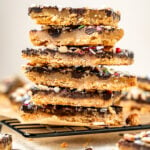
Christmas crack, also called saltine cracker toffee, is a sleeve of saltines under a three minute brown sugar toffee, baked briefly and covered in melted chocolate. Five ingredients, no special equipment, and it breaks into shards that pack beautifully into gift tins.
- Prep Time: 10 minutes
- Set Time: 1 hour 30 minutes
- Cook Time: 12 minutes
- Total Time: 1 hour 50 minutes
- Yield: About 40 pieces 1x
- Category: Candy
- Method: Baking
- Cuisine: American
Ingredients
Units
Scale
Base and toffee
- About 40 saltine crackers (one sleeve plus a few extra), enough to cover the pan in a single layer
- 225 g (1 cup, 2 sticks) unsalted butter, cut into pieces
- 200 g (1 cup, packed) dark brown sugar
- 1 teaspoon vanilla extract
- 1/4 teaspoon fine sea salt
Topping
- 300 g (2 cups) semisweet chocolate chips
- Flaky sea salt, for finishing
- Optional: 60 g (1/2 cup) chopped toasted pecans
- Optional: 2 tablespoons crushed candy canes
- Optional: Christmas sprinkles
Instructions
- Preheat the oven to 200°C (400°F). Line a 25 x 38 cm (10 x 15 inch) rimmed baking sheet with foil, pressing it into the corners and up the sides, then lay a sheet of baking paper on top of the foil. The foil holds the shape and the paper stops the toffee sticking.
- Arrange the crackers in a single tight layer, salted side up, edges touching, trimming a few to fill any gaps at the ends. They must cover the whole base or the toffee will run underneath.
- Put the butter and brown sugar in a medium saucepan over medium heat. Stir until the butter melts and the sugar dissolves, then bring to a full rolling boil, stirring constantly with a heatproof spatula and scraping the base of the pan.
- Once it reaches a full boil, set a timer and keep it boiling for exactly 3 minutes, stirring the whole time. The mixture will thicken, turn a shade darker and look like a smooth caramel. Do not stop stirring or it can separate.
- Take the pan off the heat and stir in the vanilla and salt. It will bubble up. Immediately pour the toffee over the crackers, starting at one end and working across, then spread quickly with an offset spatula to cover every cracker. Work fast, it begins to set within a minute.
- Bake for 5 to 6 minutes, until the toffee is bubbling across the whole surface. It will look loose and glossy. If a few crackers have floated out of line, nudge them back with a spatula as soon as the pan comes out.
- Scatter the chocolate chips evenly over the hot toffee and leave for 3 to 4 minutes until they look soft and shiny. Spread the melted chocolate into an even layer with the offset spatula.
- Sprinkle with flaky salt and any toppings while the chocolate is still wet, pressing nuts in lightly so they stick.
- Cool at room temperature for 30 minutes, then refrigerate for 1 hour, until the chocolate is firm and the toffee is hard.
- Lift the whole slab out by the foil, peel off the paper and break into rough pieces with your hands. Shards look better than squares.
Notes
- The three minute boil is the whole recipe. Under boil and the toffee stays chewy and soaks into the crackers instead of setting hard. Over boil and it turns dark and bitter. Time it from a full rolling boil, not from when the butter melts, and keep stirring. If you have a thermometer, you are aiming for about 120°C (250°F).
- Which cracker: saltines are the classic because the salt and the dry, open texture carry the toffee. Ritz, club crackers or graham crackers all work and give a richer, softer base. Matzo is the Passover version of the same idea.
- Chocolate: chips are easiest because they melt in place. Chopped dark chocolate at 55 to 70 per cent melts the same way and tastes better. White chocolate works but scorches if the toffee is very hot, so wait a minute before scattering it.
- Toppings that work: toasted pecans or almonds, crushed candy canes, crushed pretzels, toffee bits, flaky salt, sprinkles for a Christmas look. Add them while the chocolate is wet.
- Make ahead and storage: keeps in an airtight container in the fridge for 2 weeks, with baking paper between layers, and is best served cold or at cool room temperature. It freezes for 3 months. It softens in a warm room, so pack gift tins at the last minute.
- Troubleshooting: toffee separated into a greasy layer, it was not stirred constantly or the heat was too high. Toffee is grainy, the sugar crystallised, so stir until fully dissolved before it boils. Toffee stayed chewy, it was under boiled or under baked. Chocolate would not melt, put the pan back in the turned off oven for 1 minute.
Nutrition
- Serving Size: 1 piece
Find it online: https://zhangcatherine.com/christmas-crack-recipe/