Gingerbread Cake
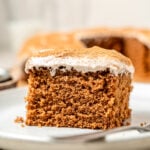
An old fashioned gingerbread cake, dark with molasses and warm with ginger, cinnamon, cloves and nutmeg. A cup of boiling water goes in at the end to keep the crumb open and moist, and a soft cinnamon cream cheese frosting finishes it. Makes 12 squares and tastes even better on day two.
- Prep Time: 20 minutes
- Cool Time: 1 hour 30 minutes
- Cook Time: 40 minutes
- Total Time: 2 hours 30 minutes
- Yield: 12 squares 1x
- Category: Cake
- Method: Baking
- Cuisine: American
Ingredients
Units
Scale
Cake
- 280 g (2 1/4 cups) all purpose flour
- 2 teaspoons ground ginger
- 1 1/2 teaspoons ground cinnamon
- 1/2 teaspoon ground cloves
- 1/4 teaspoon ground nutmeg
- 1/2 teaspoon fine sea salt
- 115 g (1/2 cup, 1 stick) unsalted butter, softened
- 150 g (3/4 cup, packed) dark brown sugar
- 2 large eggs, at room temperature
- 250 g (3/4 cup) unsulphured molasses (not blackstrap)
- 1 teaspoon vanilla extract
- 1 1/2 teaspoons baking soda
- 240 ml (1 cup) boiling water
Cream cheese frosting
- 170 g (6 oz) full fat block cream cheese, at room temperature
- 60 g (1/4 cup) unsalted butter, softened
- 180 g (1 1/2 cups) powdered sugar, sifted
- 1 teaspoon vanilla extract
- 1/4 teaspoon ground cinnamon
- Pinch of fine sea salt
- Extra ground cinnamon for dusting, or chopped crystallised ginger
Instructions
- Preheat the oven to 175°C (350°F). Grease a 23 cm (9 inch) square pan and line the base and two sides with a strip of baking paper that overhangs, so the cake can be lifted out.
- Whisk the flour, ginger, cinnamon, cloves, nutmeg and salt together in a medium bowl.
- In a large bowl, beat the butter and brown sugar with a hand mixer on medium for about 2 minutes, until lighter in colour and creamy. Beat in the eggs one at a time, then the molasses and vanilla. The mixture will look loose and slightly curdled, which is normal.
- Stir the baking soda into the boiling water in a heatproof jug. It will fizz.
- Add a third of the flour mixture to the batter and mix on low until just combined. Add half the hot water and mix. Repeat with another third of the flour, the rest of the water, then the last of the flour, mixing only until no dry streaks remain. The batter is thin, more like a thick pancake batter than a cake batter. Do not keep mixing to thicken it.
- Pour into the prepared pan and bake for 35 to 40 minutes, until the top springs back when pressed lightly and a skewer in the centre comes out with a few moist crumbs but no wet batter. The centre will dome slightly and settle as it cools.
- Cool in the pan for 15 minutes, then lift out onto a wire rack and cool completely, about 1 hour 15 minutes. Frosting a warm cake will melt it.
- For the frosting, beat the cream cheese and butter together on medium until smooth with no lumps, about 1 minute. Add the powdered sugar, vanilla, cinnamon and salt and beat on low until combined, then on medium for 30 seconds until fluffy. Do not over beat, cream cheese frosting gets runnier the longer it is whipped.
- Spread the frosting over the cooled cake in loose swoops with the back of a spoon. Dust with a little cinnamon or scatter with crystallised ginger. Cut into 12 squares.
Notes
- Molasses: use unsulphured molasses, sometimes labelled original or robust. Blackstrap is bitter and will take over the cake. Golden syrup or treacle work in a pinch but give a lighter, less gingery result. Dark corn syrup does not work.
- Why boiling water: hot water dissolves the molasses and sugar fully and loosens the batter, which gives the open, tender crumb old fashioned gingerbread is known for. It also blooms the spices. The batter is meant to be thin.
- Spice level: this is a medium ginger. For a stronger kick, add 1 tablespoon of finely grated fresh ginger with the molasses, or 1 teaspoon more ground ginger. For a milder cake, drop the cloves to 1/4 teaspoon.
- Without frosting: the cake is traditionally served plain and warm with lightly sweetened whipped cream, or just a dusting of powdered sugar. Both are fine, and the plain cake freezes better.
- Pan swaps: a 23 cm (9 inch) round pan works with the same bake time. A 33 x 23 cm (13 x 9 inch) pan gives a thinner cake, bake 25 to 30 minutes. For a loaf, use a 23 x 13 cm (9 x 5 inch) tin and bake 50 to 60 minutes, tenting with foil after 40 if the top darkens.
- Make ahead and storage: the unfrosted cake keeps wrapped at room temperature for 3 days and is better on day two as the spices settle. It freezes for 3 months. Once frosted, keep covered in the fridge for up to 4 days and bring to room temperature before serving.
Nutrition
- Serving Size: 1 square
Find it online: https://zhangcatherine.com/gingerbread-cake/