Chocolate Crinkle Cookies
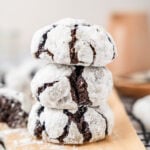
Soft, fudgy chocolate crinkle cookies with a bright white crackle. A double sugar coating keeps the white opaque instead of grey, and a long cold chill is what tears the crust into wide, deep fissures.
- Prep Time: 20 minutes
- Chill Time: 4 hours
- Cook Time: 25 minutes
- Total Time: 4 hours 45 minutes
- Yield: 24 cookies 1x
- Category: Dessert
- Method: Baking
- Cuisine: American
Ingredients
Units
Scale
Cookie dough
- 200 g (1 cup) granulated sugar
- 80 ml (1/3 cup) neutral oil, such as canola, vegetable or sunflower
- 2 large eggs, at room temperature
- 2 tsp vanilla extract
- 100 g (3.5 oz) dark chocolate, 55 to 70 per cent, melted and cooled to just warm
- 190 g (1 1/2 cups) plain (all purpose) flour
- 65 g (3/4 cup) Dutch process cocoa powder
- 1 1/2 tsp baking powder
- 1/2 tsp fine salt
Double sugar coating
- 100 g (1/2 cup) granulated sugar
- 120 g (1 cup) icing (powdered) sugar
Instructions
- Whisk the granulated sugar and oil together in a large bowl until the mixture looks like wet sand, about 30 seconds. There is no butter to cream here, so this takes no effort.
- Whisk in the eggs one at a time, beating well after each, then the vanilla. The mixture should loosen and turn glossy.
- Pour in the melted, cooled chocolate in a steady stream while whisking. If the chocolate is too hot it will scramble the egg, so let it come down to barely warm first.
- Sift the flour, cocoa, baking powder and salt directly over the bowl. Fold with a spatula just until no dry streaks remain. The dough will be very soft and sticky at this stage, which is correct. Do not add more flour.
- Cover the bowl and chill for at least 4 hours, preferably overnight. This step is not optional: cold dough spreads slowly in the oven, and slow spread is what tears the sugar crust into deep crackles.
- Heat the oven to 175 C (350 F) and line two baking trays with parchment. Set out two shallow bowls, one with the granulated sugar and one with the icing sugar.
- Scoop the cold dough into 30 g balls (a level tablespoon and a half) and roll each one smooth between your palms. Work quickly so the dough stays cold.
- Roll each ball first in the granulated sugar, then drop it into the icing sugar and turn it until it is thickly and completely white. The granulated layer is the trick: it sits between the wet dough and the icing sugar and stops the icing sugar dissolving, so the coating stays bright and opaque instead of going grey and patchy. Be generous, a thin coat will disappear in the oven.
- Place 12 per tray, about 5 cm (2 in) apart. They spread more than they look like they will.
- Bake one tray at a time for 11 to 13 minutes, until the cookies have puffed, cracked open across the top and the edges are set but the centres still look slightly underdone and soft when you press them.
- Cool on the tray for 10 minutes before moving to a rack. They finish setting as they cool, and lifting them early will break them.
Notes
- Cocoa: natural cocoa works in place of Dutch process but gives a redder, sharper, less fudgy cookie. Use Dutch process if you can get it.
- Without the dark chocolate: leave it out for a lighter, more old fashioned crinkle and add 15 g more cocoa and 20 g more oil.
- Butter instead of oil: melted butter can replace the oil, but the cookie sets firmer and is less fudgy the next day, which is why oil is the better choice here.
- Make ahead: the dough keeps covered in the fridge for 3 days and improves after the first night. Rolled, uncoated balls freeze for 3 months. Coat them in the two sugars straight from frozen and add 2 minutes to the bake.
- Storage: baked cookies keep in an airtight tin for 4 days and stay soft.
- No crackle: the dough was not cold enough, or the coating was too thin. Chill longer and coat more heavily.
- Spread flat: too little flour or an over warm kitchen. Chill the scooped balls for 15 minutes on the tray before baking.
Nutrition
- Serving Size: 1 cookie
Find it online: https://zhangcatherine.com/chocolate-crinkle-cookies/