Japanese Castella Cake (Kasutera)
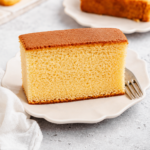
Japanese castella cake, or kasutera, is the honey sponge from Nagasaki: dense, moist and faintly chewy, with a deep chestnut crust and a sugar crust on the base. Five ingredients, no special tin, and an overnight rest that does all the work.
- Prep Time: 25 minutes
- Rest: 12 hours
- Cook Time: 50 minutes
- Total Time: 13 hours 15 minutes
- Yield: 10 slices 1x
- Category: Dessert
- Method: Baking
- Cuisine: Japanese
Ingredients
Units
Scale
Cake
- 6 large eggs, at room temperature
- 1 cup (200 g) caster sugar
- 1/4 cup (85 g) honey, plus 1 tablespoon for the glaze
- 3 tablespoons whole milk, warm
- 1 1/3 cups (170 g) bread flour, sifted twice
- 1 pinch fine salt
For the Tin
- Baking paper, to line
- 1 tablespoon caster sugar, for the base (optional)
Instructions
- Heat the oven to 160 C (320 F). Line a 20 cm (8 inch) square tin with baking paper, bringing the paper about 5 cm above the rim on all sides. Scatter the tablespoon of caster sugar over the base if you want the traditional sugar crust.
- Warm the honey and milk together in a small saucepan until the honey loosens and pours easily. Set aside somewhere warm.
- Set a heatproof bowl over a pan of barely simmering water, making sure the base does not touch the water. Add the eggs, caster sugar and salt.
- Beat with an electric mixer over the water for 2 to 3 minutes, until the mixture is warm to the touch, about body temperature. Lift the bowl off the heat.
- Keep beating on high for 6 to 8 minutes, until the mixture has tripled in volume, turned very pale, and holds a ribbon on the surface for a full 5 seconds when you lift the beaters.
- Pour in the warm honey and milk and beat on low for 30 seconds to combine.
- Sift the bread flour over the surface in three additions, folding gently with a spatula after each. Stop the moment no dry flour is visible.
- Pour the batter into the lined tin from a height of about 30 cm. Drag a skewer through the batter in a zigzag ten times, then tap the tin firmly on the bench three times.
- Bake for 10 minutes at 160 C (320 F), then drop the oven to 150 C (300 F) and bake for a further 35 to 40 minutes, until the top is deep chestnut brown and a skewer comes out clean.
- Take it out and immediately drop the tin onto the bench from about 20 cm. This sets the crumb and stops the cake shrinking as it cools.
- Brush the top with the remaining tablespoon of honey. Turn the cake out, peel the paper from the sides only, and wrap the whole loaf tightly in cling film while still warm, top side down.
- Rest at room temperature for at least 12 hours, ideally overnight. Trim the four sides, then slice into thick fingers with a hot, wet knife.
Notes
- Bread flour is not optional. Its higher protein is what gives castella the faintly chewy, close crumb that separates it from an ordinary sponge.
- There is no baking powder, no baking soda, no oil and no butter. All the lift comes from the eggs and all the moisture comes from the honey and the overnight rest.
- Room temperature eggs whip to far greater volume than cold ones. If you forget, sit them in warm water for 5 minutes.
- The overnight wrap is the whole technique. Wrapping the cake while hot traps the steam and redistributes it through the crumb. Castella eaten straight from the oven is disappointing and the next day it is excellent.
- Use a mild honey. Strong varieties such as manuka will dominate. Nagasaki castella traditionally uses a light wildflower honey.
- Wrapped, it keeps at room temperature for 3 days and improves on days two and three. Do not refrigerate, it dries out. It freezes well sliced for up to 1 month.
Nutrition
- Serving Size: 1 slice
Find it online: https://zhangcatherine.com/japanese-castella-cake/