The Best Pistachio Baklava Recipe with Honey Lemon Syrup
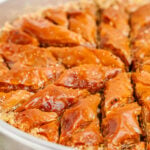
Crisp layers of buttered phyllo packed with a pistachio and walnut filling, baked to a deep gold and soaked the moment it leaves the oven with a cool honey lemon syrup.
- Prep Time: 45 minutes
- Rest Time: 6 hours
- Cook Time: 1 hour 15 minutes
- Total Time: 8 hours 15 minutes
- Yield: 24 pieces 1x
- Category: Dessert
- Method: Baking
- Cuisine: Middle Eastern
Ingredients
Units
Scale
Honey lemon syrup
- 300 g (1 1/2 cups) granulated sugar
- 240 ml (1 cup) water
- 170 g (1/2 cup) honey
- 2 tablespoons lemon juice
- 3 wide strips lemon zest, pared with a peeler
- 1 cinnamon stick
Pistachio and walnut filling
- 185 g (1 1/2 cups) shelled unsalted pistachios
- 200 g (2 cups) walnut halves
- 50 g (1/4 cup) granulated sugar
- 1 1/2 teaspoons ground cinnamon
- 1/4 teaspoon fine salt
Assembly
- 454 g (1 pound) frozen phyllo pastry, thawed overnight in the fridge
- 280 g (1 1/4 cups) unsalted butter, melted
- 2 tablespoons finely chopped pistachios, to finish
Instructions
- Make the syrup first, because it has to be cool when it meets the hot baklava. Put the sugar, water, honey, lemon juice, lemon zest strips and cinnamon stick in a small saucepan. Stir over medium heat until the sugar dissolves, then bring to a simmer and cook for 10 minutes without stirring. Take it off the heat and leave it to cool completely, at least an hour. Fish out the zest and the cinnamon stick before using.
- Clarify the butter. Melt the butter gently, then leave it to settle for 5 minutes. Skim the foam off the top and pour off the clear golden fat, leaving the milky solids behind in the pan. Those solids are what make phyllo go soft and spotty, so discard them. Keep the clarified butter warm and liquid.
- Heat the oven to 165 C (325 F), with a rack in the middle. Brush a 9×13 inch (23×33 cm) metal pan with butter.
- Make the filling. Pulse the pistachios and walnuts in a food processor in short bursts until they look like coarse breadcrumbs with a few bigger pieces left in. Stop before they turn to paste. Tip into a bowl and stir through the sugar, cinnamon and salt.
- Prepare the phyllo. Unroll the stack and trim it to the footprint of your pan with a sharp knife, cutting through the whole stack at once. Cover it with a sheet of baking paper and then a clean, barely damp tea towel. Keep it covered the entire time you work, phyllo dries out in about two minutes uncovered.
- Build the base. Lay one sheet in the pan and brush it all over with clarified butter, working from the edges inward so you do not drag and tear it. Repeat until you have 10 buttered sheets stacked.
- Scatter a third of the nut mixture evenly over the pastry, right into the corners.
- Stack 5 more buttered sheets on top, then another third of the nuts. Then 5 more buttered sheets and the last third of the nuts.
- Finish the top. Stack the remaining sheets on top, buttering each one, and butter the final sheet generously. Aim for 10 sheets on top, which gives a thick crown that holds its shape and stays crisp. If your phyllo count leaves you short, take the extra sheets from a middle layer rather than the top or the base.
- Cut before baking, not after. Using a sharp thin knife, cut all the way to the bottom of the pan. Cut 4 straight lines down the long side to give 5 strips, then cut diagonally across them to make diamonds, or straight across for 24 squares. Cutting raw is the only way to get clean edges.
- Bake for 1 hour 15 minutes, until the whole surface is a deep, even golden brown and the edges have visibly pulled from the pan. Pale baklava tastes raw and goes soggy, so take it further than feels comfortable. If the top is browning faster than the middle, tent it loosely with foil for the last 20 minutes.
- Syrup goes on immediately. The moment the pan leaves the oven, pour the cool syrup slowly and evenly over the hot pastry, going back over the cut lines so it runs down into them. It will hiss and bubble. Never pour hot syrup onto hot pastry, and do not let the baklava cool first.
- Scatter the finely chopped pistachios over the top while the surface is still wet.
- Rest at room temperature, uncovered, for at least 6 hours and preferably overnight. The syrup needs the time to travel all the way through. Run the knife through the cut lines again before lifting the first piece out.
Notes
- Pan shape. The photos show this built in a round tin rather than the 9×13 inch rectangle. Both work. Cut a round tin the same way: parallel lines across it, then diagonals through them.
- Substitutions. All walnut is the traditional Greek version and all pistachio is the Turkish one, so any ratio between them works. Pecans stand in for walnuts. Almonds are firmer and less rich, so use them for no more than half. Maple syrup can replace the honey, though it dulls the flavour. Orange zest instead of lemon, or a tablespoon of rose or orange blossom water stirred into the cooled syrup, both work.
- Make ahead. Baklava is better on day two and holds for 5 days at room temperature, loosely covered, never in the fridge, where the phyllo goes leathery and the syrup weeps.
- Freezing. Freeze baked and syruped pieces in a single layer for up to 3 months and thaw uncovered at room temperature. You can also assemble the whole unbaked tray, cut it, wrap it well and freeze it, then bake from frozen with 10 to 15 minutes added.
- Troubleshooting. A soggy bottom means the syrup was hot, the baklava was cool, or it was underbaked. Syrup pooling on the surface means the pieces were not cut to the base. Butter leaking out during baking means the butter was not clarified. A top layer that lifts away from the filling means the crown was too thin.
Nutrition
- Serving Size: 1 piece
Find it online: https://zhangcatherine.com/pistachio-baklava-recipe/