
The softest and fluffiest wobbly sponge cake. Originating in Taiwan this souffle castella is lightly sweetened with the perfect pillowy texture.
One of the most satisfying things is baking a perfect sponge cake. When the cake is at the perfect height and the surface is perfectly smooth and crack free. This castella is the definition of a perfect sponge cake. You won’t find a cake with a better texture than this! The cake itself is light in flavour and slightly sweet, and the texture is light, pillowy and souffle-like.
Originating in Taiwan, these cakes are usually baked as large 1 metre slabs, sliced into large rectangles straight out of the oven, and placed in boxes to be picked up by the long line of customers waiting outside the stores. The popularity of these cakes is never-ending, and there are almost always lines outside the stores.
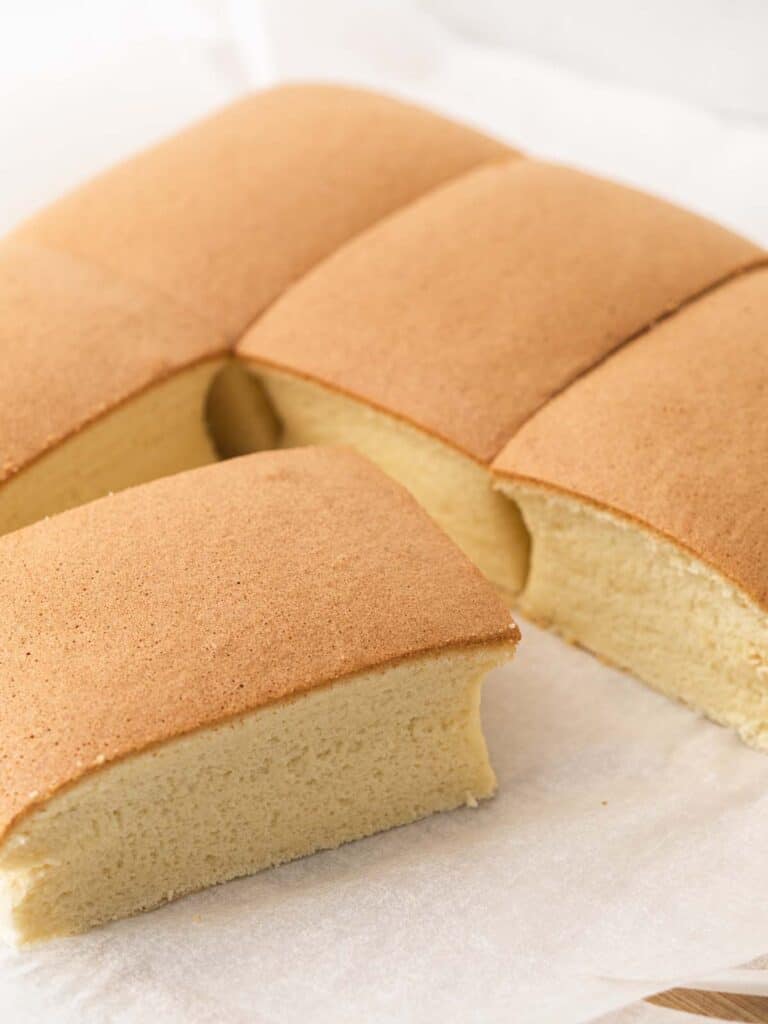
What is castella cake?
Although souffle castella was popularised in Taiwan, the original castella is a cake developed in Japan after being introduced by the Portugese. A traditional Japanese sweet made from bread flour, eggs, sugar and mizuame, a type of sugar syrup which gives the cake a moist texture, Japanese castella is a denser and slightly gooier in texture with a darker crust.
Instead of being baked on a large scale like the Taiwanese adaptation, Japanese castella is baked in a wooden square or rectangular mould and enjoyed the day after it is baked as it brings out a moister texture.
While both cakes may have the same name they have their own unique charms. I personally love the Taiwanese castella cake because of its fluffy texture, but give this recipe a go and see what you think!
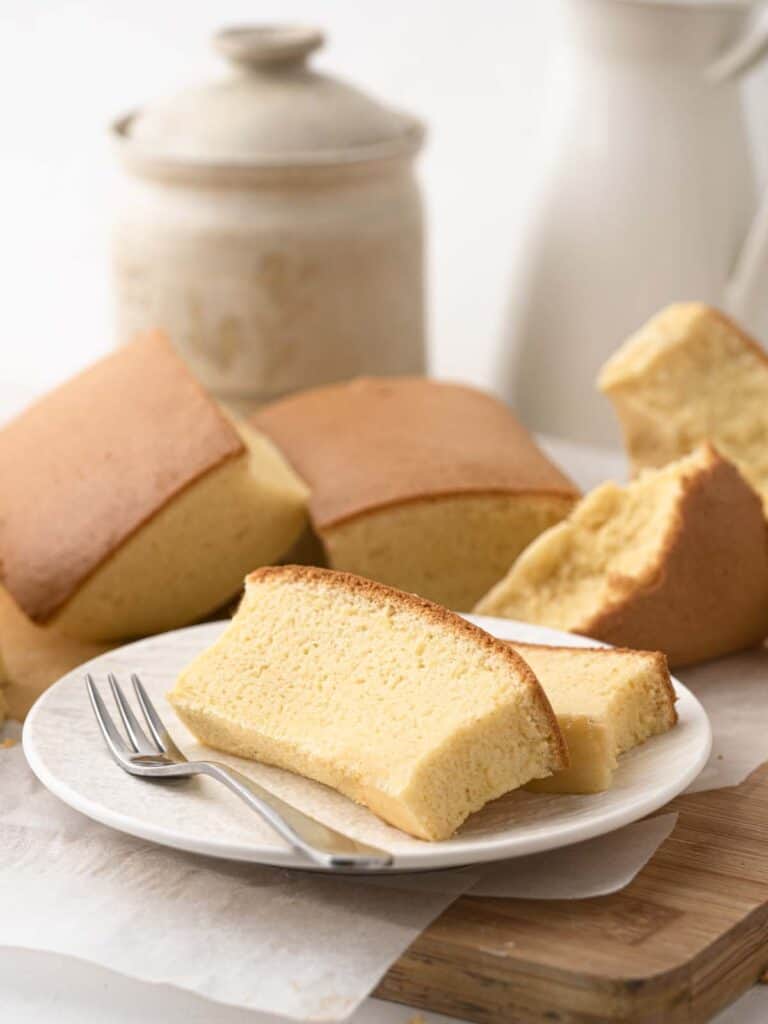
How to achieve a crack free cake
Sponge cakes are the kind of cake that seems relatively simple, but there are so many small areas where things can go wrong. Whether that be a sunken cake or a cracked top follow these steps for the perfect castella!
Heat the milk and butter until just melted
Heating the milk and butter is one of the tricks to achieving a cotton soft sponge cake. This technique is called the ‘cooked dough’ method, and essentially breaks down the proteins in the flour so that less gluten is formed, creating a soft sponge.
However, when heating the milk and butter keep a close eye on it so it doesn’t overheat. If the milk and butter is too hot it can overcook the dough, causing it to form a sticky paste. The butter should have just melted and the milk should be just steaming.
Use chilled eggs
Chilled eggs whip up to create a firmer, more stable meringue. The meringue forms the base of this cake, helping it rise while giving it it’s fluffy texture, so it is essential to have a strong foundation. You can also add a pinch of cream of tartar to your egg whites once foamy to help strengthen the meringue.
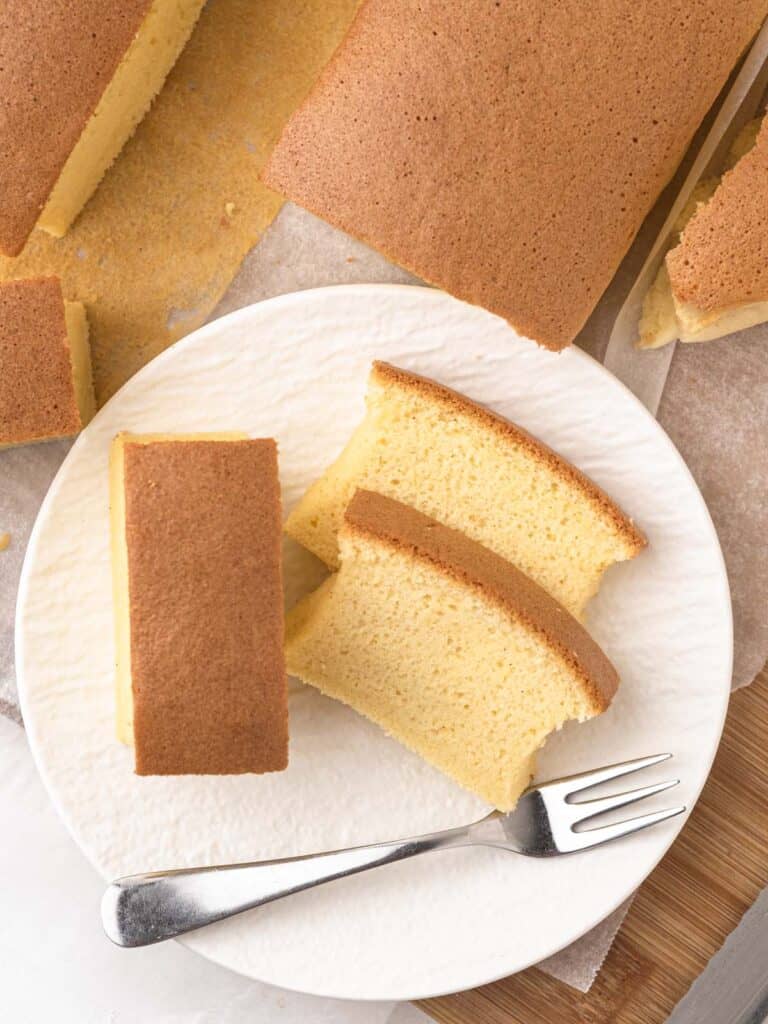
Whip the egg whites to soft peaks
One of the most important tips to creating a crack free sponge cake is only whipping the egg whites to soft peaks. If the meringue is whipped to stiff peaks it can cause the cake to rise rapidly while baking, increasing the possibility of the top splitting.
Add the sugar when the egg whites are just foamy, and whip until a dense meringue
While the egg whites should be whipped to soft peaks it is important to ensure that the soft peaks are dense and stable. The best way to create a stable meringue is to add the sugar as soon as the egg whites are foamy and beat the egg whites on medium-low for a longer period of time. This gives time for the sugar to dissolve, and the proteins in the egg whites to form a stronger network. When you look at the meringue the air bubbles should be fine and the surface should be shiny.
Bake the cake in a hot water bath
Baking the cake in a hot water bath helps to even out the oven temperature and create the perfect moist environment for the cake to bake. It is important to even out the oven temperature, as fluctuations in heat can cause the sponge cake to crack. Extra moisture also prevents the surface of the cake from drying out and becoming more susceptible to splitting.
Make sure the water you use in the hot water bath is hot, but not boiling. Boiling water evaporates quicker and could leave your cake dry halfway through the baking process.
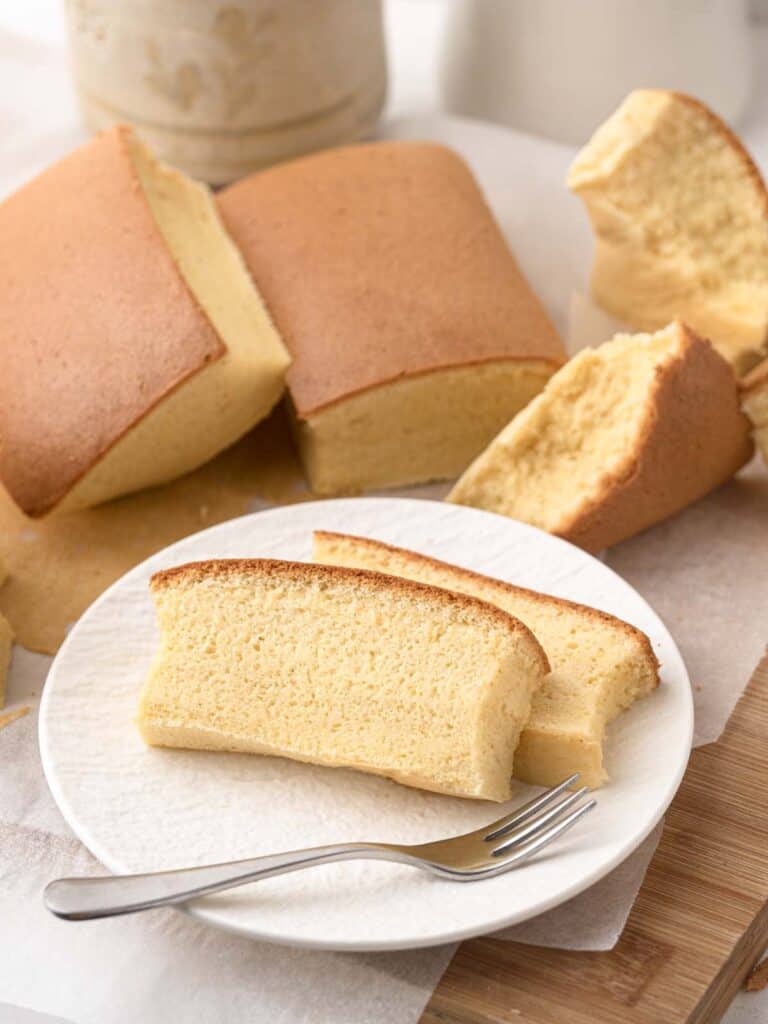
How to make Souffle Castella Cake (with pictures)
- Preheat the oven to 140C
- Combine the milk and butter in a small saucepan over medium heat and heat until the butter has melted and the milk is just steaming


- Sift the flour into a large bowl and pour over the hot milk and butter, mix until combined
- Add the egg yolks and mix until smooth and well combined
- In a large bowl add the egg whites and whisk until foamy


- Add the sugar and beat on medium-low until the meringue reaches soft to medium peaks
- Add 1/3 of the meringue to the yolk mixture and mix until well combined
- Add the lightened yolk mixture to the remaining meringue and gently use a whisk to fold the mixture until just combined


- Transfer the batter to the lined tin and place it in a larger baking tray filled with hot, but not boiling, water
- Bake for 75 minutes or until the cake springs back when touched
- Remove from the oven and enjoy warm!

Ingredients in Souffle Castella Cake
- Whole milk: Provides moisture, richness, and contributes to the tenderness and smoothness of the batter.
- Unsalted butter: Adds fat, enriching flavor, tenderizing the crumb, and helping with the cake’s structure and texture.
- All-purpose flour: Provides structure and body, forming gluten that helps the cake rise and hold its shape.
- Large egg yolks: Add richness, color, flavor, and contribute to a smooth batter and overall richness.
- Vanilla extract: Adds flavor and enhances the cake’s taste and aroma.
- Large egg whites: Provide structure and volume, creating a light, airy texture by incorporating air into the batter.
- White sugar: Adds sweetness, stabilizes whipped egg whites, and creates a stable meringue for structure and rise.
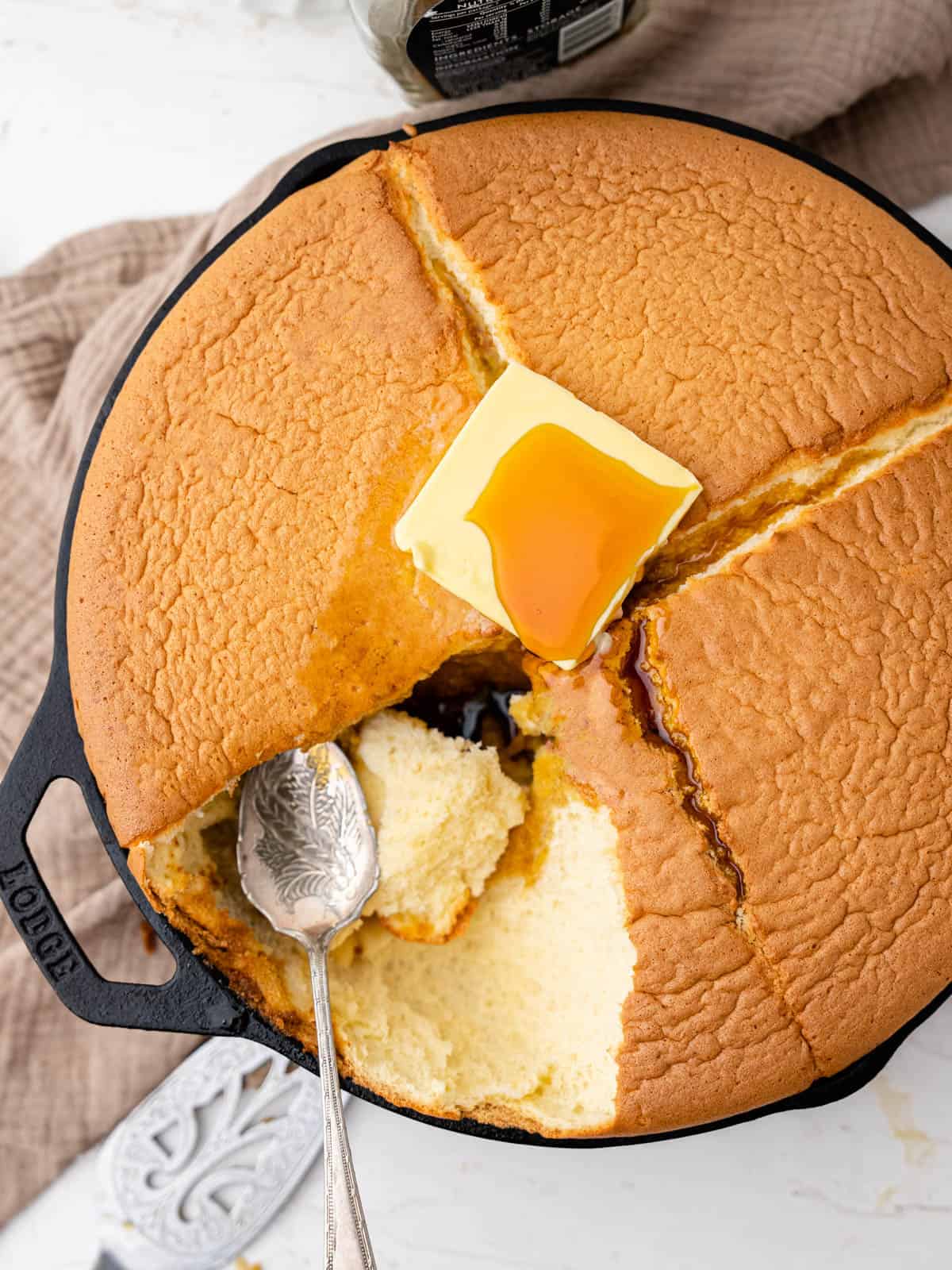
Tips for Perfect Souffle Castella Cake
- Use room temperature butter for smoother batter consistency: Room temperature butter blends more evenly with the egg mixture, ensuring a smooth, lump-free batter that gives the cake a consistent texture.
- Let the cake cool in the oven for 10 minutes: After baking, leave the cake inside the turned-off oven with the door slightly ajar. This gradual cooling prevents the sudden temperature drop, which can cause deflation.
- Sift flour multiple times: Sifting the flour two or three times eliminates clumps and incorporates air, making the cake even lighter and fluffier.
- Choose the Right Pan: Soufflé castella thrives in the right environment. An 8-inch square or deep loaf pan gives enough room for the batter to rise tall without spilling over. Always line with parchment so the cake lifts cleanly.
- Tap Out Air Bubbles: Before sliding the pan into the oven, gently tap it on the counter two or three times. This little trick pops large bubbles that can create unsightly holes in your otherwise pillowy sponge.
- Protect the Top with Foil: If your oven runs hot, the surface can brown before the inside sets. Drape a piece of foil loosely over the pan halfway through baking. It shields the top while keeping the crumb moist and tender.
- Watch for the Jiggle Test: Instead of relying only on time, gently shake the pan at the end of baking. The cake should wobble softly, almost like pudding, while the surface springs back to a light touch.
- Cool in Stages: Rather than removing the cake straight into cool air, turn off the oven, crack the door open, and let the castella sit for 10 to 15 minutes. This slow transition prevents dramatic shrinkage.
- Position Your Oven Rack: Bake on the lower rack if your oven tends to overheat from the top. This small shift keeps the cake’s crown pale and silky without scorching.
- Steam Control in the Water Bath: Keep your water hot but not boiling when setting up the water bath. Too vigorous steam can toughen the edges of the sponge. A steady, gentle heat nurtures that cloud-like crumb.
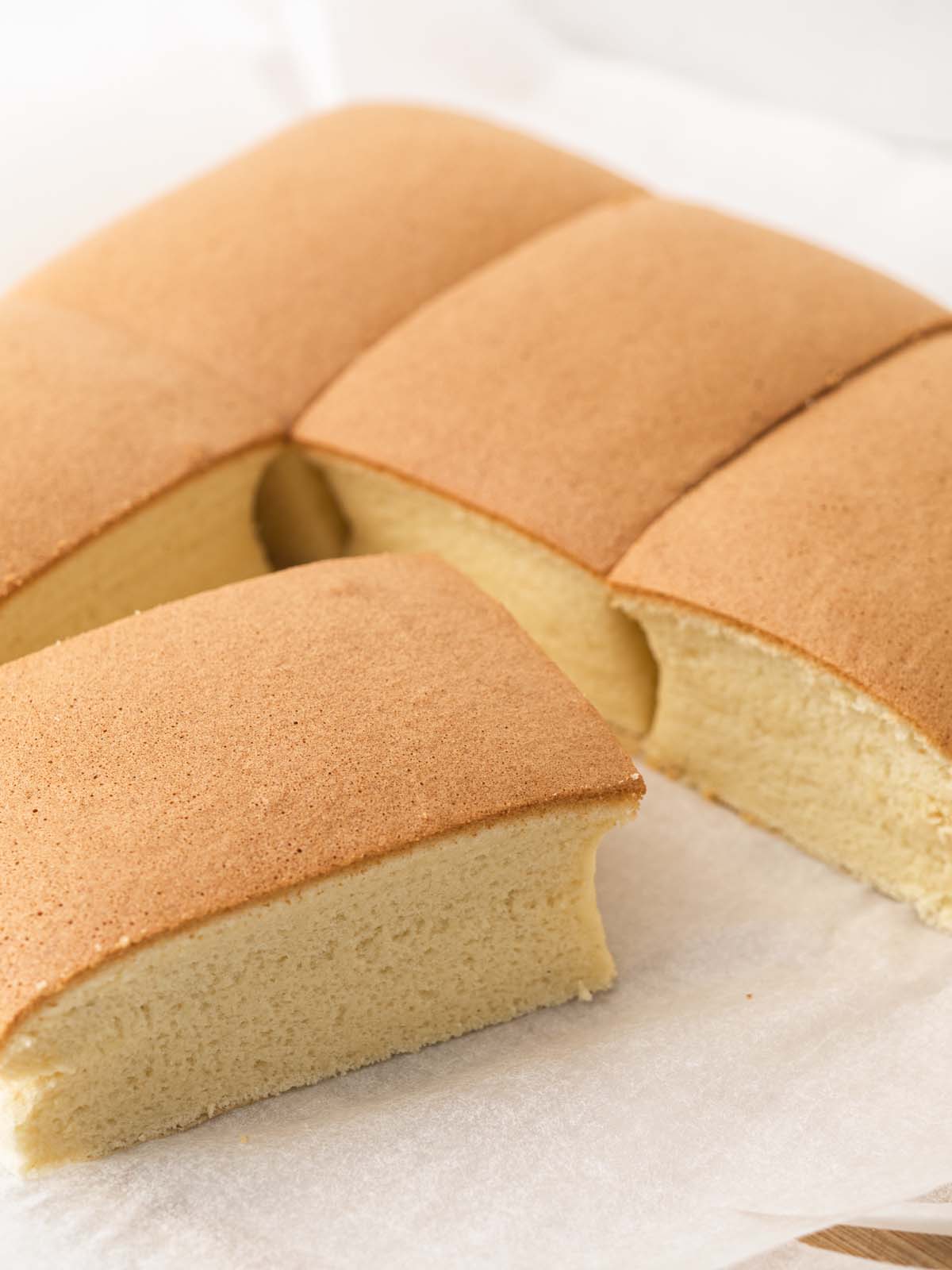
Variations
- Add matcha powder for a green tea twist: Incorporate 1 to 2 tablespoons of matcha powder into the flour for a delicate, earthy flavor and a subtle green color, perfect for matcha lovers.
- Mix in lemon zest or extract for a citrusy aroma: A teaspoon of lemon zest or a few drops of lemon extract can brighten the flavor, balancing the sweetness with a refreshing citrus note.
- Fold chocolate chips into the batter for a surprise flavor: Gently mix in semi-sweet or dark chocolate chips before baking to add bursts of rich, chocolatey goodness to each bite.
- Honey Castella: Swap part of the sugar for honey to honor the Japanese tradition. It gives a golden crust, floral aroma, and subtle depth of sweetness.
- Cheese Cloud Castella: Fold shredded cheddar or mozzarella into the batter for a playful sweet-savory twist. The melted cheese hides inside like a delightful surprise.
- Berry Jam Swirl Castella: Add a thin layer of raspberry or blueberry jam before baking. When sliced, you’ll reveal jewel-like ribbons against the pale sponge.
- Coffee Infused Castella: Stir a spoonful of espresso powder into the warm milk before mixing. The cake emerges fragrant, airy, and perfect for pairing with a morning latte.
- Earl Grey Castella: Steep Earl Grey tea in the warm milk, then strain before using. Its delicate citrus-floral notes transform the sponge into an elegant afternoon tea companion.
- Chocolate Marble Castella: Prepare a portion of cocoa batter and gently swirl it through the plain mixture. Slice through to reveal marbled ribbons that look as beautiful as they taste.
Serving Suggestions
- Serve warm with a dollop of vanilla ice cream: The contrast between the warm, fluffy cake and cold, creamy ice cream creates a delightful sensory experience.
- Pair with a drizzle of salted caramel sauce: Add a decadent touch by drizzling homemade or store-bought salted caramel over the cake, enhancing the sweetness with a hint of saltiness.
- Add fresh berries and a sprinkle of powdered sugar: For a light and fresh presentation, garnish the cake with raspberries, strawberries, or blueberries, and dust with powdered sugar to elevate the visual appeal.
- Cream Sandwich Castella: Slice the sponge horizontally and pipe whipped cream or pastry cream in between. Each bite becomes a soft pillow filled with sweetness.
- Castella Trifle: Cut the cake into cubes and layer them with custard, cream, and fresh fruit. The sponge absorbs the flavors, creating a luxurious spoon-dessert.
- French Toast Castella: Dip leftover slices in egg custard, pan fry until golden, and serve with syrup. The edges caramelize while the centers stay soft and custardy.
- Parfait Glasses with Castella: Crumble the cake into parfait glasses, layering it with yogurt, ice cream, or fruit compote. Each spoonful offers a mix of creamy and fluffy textures.
- Toasted Castella with Chocolate Dip: Lightly toast slices in the oven until crisp on the edges. Pair with melted chocolate or hazelnut spread for an irresistible contrast.
- Castella with Cheese Pairing: Serve thin slices alongside creamy brie or mascarpone. The sweet-savory balance feels refined yet playful, perfect for a chic dessert platter.
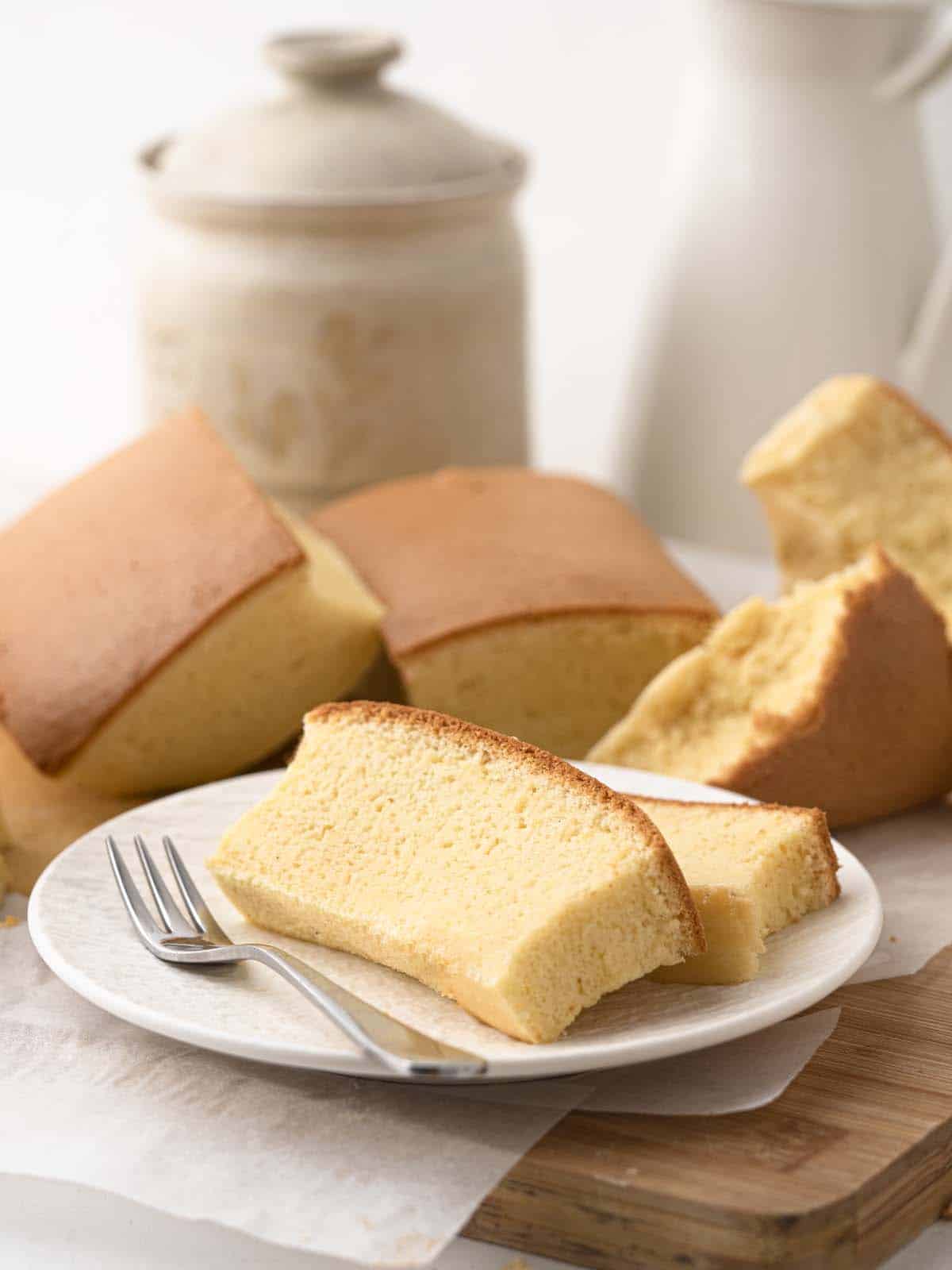
Common Mistakes to Avoid
- Wrong Pan Size: Using a pan that’s too small leads to overflowing, while one that’s too large creates a thin, dry cake. Stick to a deeper pan for even rise.
- Overfilling the Pan: The batter should fill only three-quarters of the pan. This leaves space for the cake to expand without collapsing over the edges.
- Skipping the Water Bath: The water bath maintains even heat and adds essential moisture. Without it, the cake bakes too fast on the outside and cracks across the surface.
- Over or Under Whipping Egg Whites: Egg whites whipped too stiff will create a fragile, crack-prone sponge, while under-whipped whites won’t hold structure. Aim for glossy soft-medium peaks.
- Opening the Oven Door Too Early: Resist the temptation to peek. Sudden drafts cause the cake to deflate before the crumb sets. Only open when the baking time is nearly done.
- Cooling Too Quickly: Pulling the cake straight from hot oven to cool air encourages dramatic shrinkage. Always cool gradually with the oven door slightly ajar.
Frequently Asked Questions
Why did my cake crack?
There are a couple of reasons as to why your cake cracked.
- The meringue was whipped beyond soft peaks
- The meringue wasn’t stable enough
- The oven temperature was too hot
- The water bath used was too hot/ there wasn’t enough water in the waterbath
To troubleshoot these errors check out my “how to achieve a crack-free cake” section above!
Why did my cake deflate?
As the name suggests this cake is a souffle castella, and will deflate slightly after cooling, however not enough for it to be a significant problem. If your cake is deflating a lot it could be be due to a couple of factors:
- The meringue was overwhipped, causing it to rise more during the bake
- The cake was underbaked
How long does this last?
This cake is best enjoyed on the day it’s made, but it can last up to 3 days in an airtight container in the fridge. Allow the cake to come to room temperature before consuming if eating from the fridge, or you can toast it in the oven or toaster!
How is this cake best enjoyed?
I personally love this cake when it is fresh out of the oven. At this stage the cake is warm, soft and at its fluffiest. However, when cooled the cake is equally as delicious. Try serving it with some whipped cream and fresh fruit for a delicious all round dessert!
Will cake flour make this cake softer?
I’ve tried many versions of this cake with cake flour, however, I found that regular flour holds a more stable structure when the cake is baking!
Can I make castella cake gluten-free?
Yes, substitute all-purpose flour with gluten-free cake flour or almond flour for a gluten-free version.
Why is my cake dense instead of fluffy?
Overmixing the batter or under-whipping the egg whites can cause the cake to lose its airy texture.
Can I store the cake at room temperature?
It’s best refrigerated, but if consumed within 1-2 days, room temperature storage in an airtight container is fine.
Can I Make Soufflé Castella in an Air Fryer
Yes. Use a small pan that fits inside, reduce the temperature to 130–135°C, and check for doneness about 15 minutes earlier than usual.
How Do I Keep Castella Jiggly After Cooling
Cool the cake slowly in the oven, then wrap it tightly in plastic once cooled. A quick warm-up in the microwave restores that signature bounce.
Can I Freeze Soufflé Castella Cake
Absolutely. Wrap slices in plastic wrap, then foil, and freeze for up to one month. Thaw overnight in the refrigerator for best texture.
What Is the Difference Between Taiwanese and Japanese Castella
Taiwanese castella is tall, airy, and jiggles with every touch. Japanese castella is denser, slightly sticky, and flavored traditionally with honey. Both are delicious in their own way.
Why Does My Castella Collapse in the Middle
A collapsing center often means the cake was underbaked, the meringue was over-whipped, or the oven door was opened too soon. Ensure steady low heat and proper doneness tests.
Is Soufflé Castella Healthier Than Regular Sponge Cake
Soufflé castella is lighter in fat and sugar than butter-heavy cakes, but it is still a dessert. To lighten it further, try reducing sugar or experimenting with whole-grain flour.
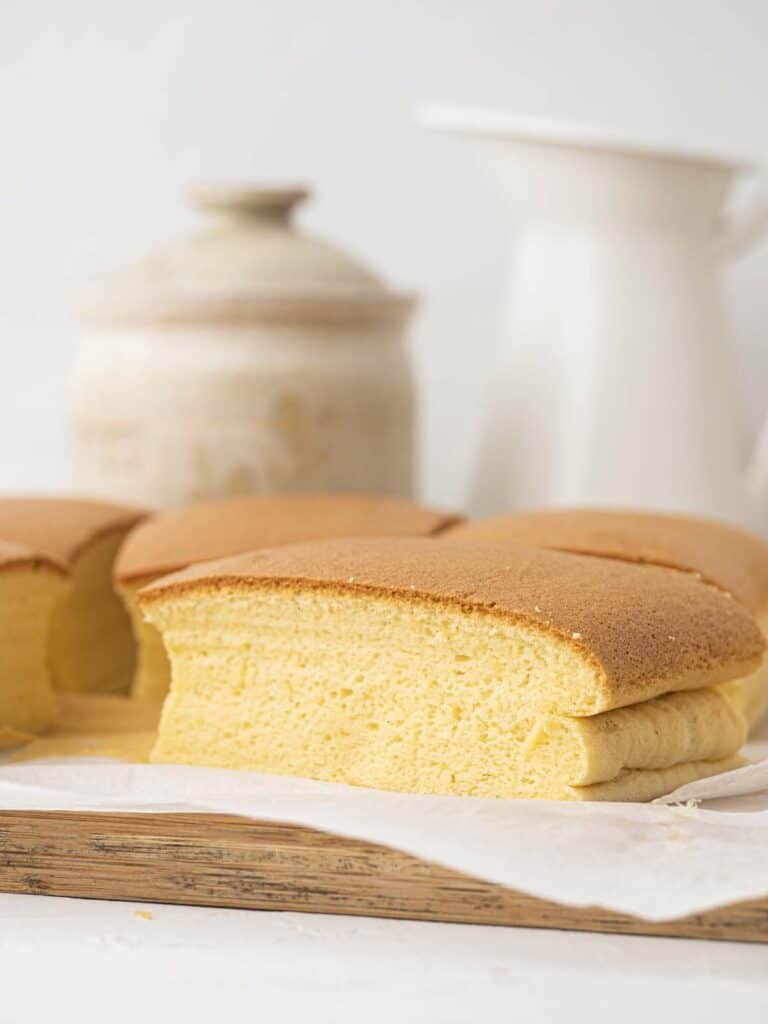
Let’s Get Cooking
If you liked this recipe make sure to leave me a comment and rating down below. I’d love to know how it went! Also, don’t forget to tag me on Instagram @catherine.desserts.
Follow me on Facebook, Pinterest, YouTube, and TikTok for more of my baking creations and updates!
Taiwanese Souffle Castella
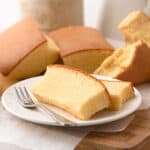
The softest and fluffiest wobbly sponge cake. Originating in Taiwan this souffle castella is lightly sweetened with the perfect pillowy texture.
- Prep Time: 15 mins
- Cook Time: 75 minutes
- Total Time: 1 hour 30 minutes
- Yield: 8 x 8 inch cake 1x
- Category: Cake
- Method: Easy
- Cuisine: Taiwanese
Ingredients
- 130g Whole milk (1/2 cup 2 tsp)
- 130g Unsalted butter (1/2 cup 2 tsp)
- 120g All purpose flour (1 cup)
- 8 Large egg yolks
- 1 tsp Vanilla extract
- 8 Large egg whites
- 130g White sugar (2/3 cup)
Instructions
- Preheat the oven to 140C and line a 8 x 8 inch / 20 x 20cm square pan with parchment paper
- Combine the milk and butter in a small saucepan over medium heat and heat until the butter has melted and the milk is just steaming
- Sift the flour into a large bowl and pour over the hot milk and butter, mix until combined
- Add the egg yolks and mix until smooth and well combined, and set aside
- In a large bowl add the egg whites and whisk on high speed until foamy with a hand mixer, or in a stand mixer fitted with a whisk attachment
- Add the sugar and beat on low speed until the meringue reaches soft to medium peaks
- Add 1/3 of the meringue to the egg yolk mixture and mix until well combined
- Add the lightened yolk mixture to the remaining meringue and gently use a whisk to fold the mixture until just combined
- Transfer the cake batter to the lined cake pan and place it in a larger baking tray filled with hot, but not boiling, water
- Bake for 75 minutes or until the cake springs back when touched
- Remove from the oven and enjoy warm!



Hi Catherine. Happy new year!!!
It is funny but I wanted to make this cake for about a month now and I kept postponing it. Now, that you made it I will definitely give it a try. Is it possible to tell us how to turn it into a matcha version?
Hi Dimosthenis, Happy new year! I haven’t tried making a matcha version, but I would replace 1 – 2 tbsp of the flour with matcha powder. Hope it turns out great!
Hi,
I’ve tried to make this cake six times now and I fail every time! I’m honestly so confused and have ran out of things to do.
So the bottom of the cake (basically at least half of it) always looks like it is wet (very wet almost like I soaked it in water) when it comes out while only the slightest bit at the top comes out right.
So far I’ve tried leaving it there longer, really paying attention to the meringue stiffness, oven temp, how much water to put around the cake but I am stumped as still the cake doesn’t come out right. Am I forgetting something?
Bottom of cake was very dense and eggy. The top was nice and fluffy. What might be the issue? Didn’t beat eggs long enough or water bath to hot. Any ideas?
Hi! Just wanted to let you know that I think the recipe needs a tweak. I went with the weight measurements so mine turned out great. But the butter should be 1/4c + 2 tbsp, not 1/2c. The recipe also states vanilla extract, but it doesn’t say when to put it in. I just stirred it in at the end.
Hi Jackie, Thanks for picking that up! The vanilla should be added with the egg yolks, as for the butter weight it should be correct as I converted it via density 🙂
Hi, instead of ap flour can I use a mixture of top flour and cake flour instead? Thank you!
So, 1/2 cup butter equals 113 grams, 1 tablespoon butter equals approx 15 grams, and 1 teaspoon equals approx 5 grams. So, 1/2 cup (113 g) + 1 tablespoon butter (15 g) = 128 g, which is close enough to 130 g. But, yeah, weighing ingredients will always yield the best results!
Hello again. I just made a matcha version and I have to say that I am amazed. It turned out great. I did it in a 9x9x2 inch pan. The ingredients should be:
150 gr Milk
150 gr Butter
127 gr Flour
10 gr matcha
9 egg yolks
9 egg whites
4.6 gr vanilla extract
150 gr White Sugar
For non-matcha just use 137 gr flour.
Hi Dimosthenis, that sounds delicious, thanks for posting it! I was going to upload a matcha version soon too 🙂
I am so sorry if I spoiled a future recipe :(. I will also try a Durian flavor next week 😀
Not at all! In fact it’s probably better since you’ve done some testing already 🙂 Durian sounds delicious!
Hi, thank you for the recipe. I made this cake and it was absolutely delicious but a tad sweet for me. Do you think it’s possible to change to brown sugar?
I also had a couple of things I want to ask. How did you get that nice brown top? Im getting a lot of cake bubbles with the final mixtures and I don’t know if it’s because I’m beating it at too high speed with the electric mixture.
Hi! I wouldn’t use brown sugar as it has extra moisture and will result in a denser cake. The brown top comes from the caramelization of the sugar. The bubbles will happen if you are beating the eggs at a high speed, make sure you beat them on a medium speed as this will prevent any large air bubbles from forming
Woohoo! I did it – made it for a friend who likes castella cake, but saying that it’s too expensive haha. I failed my first 8 egg whites because I was lazy with the washing and impulsively decided to pour the egg whites in the bowl where I made the milk/butter mixture — turns out it was AN UNFORGIVABLE BLUNDER! I managed to make the egg whites foamy, but when I added the sugar, it doesn’t form merginue! (Lessons learnt the hard way) :'( So I used all my eggs in the fridge to make another batch of merginue. PHEW! It worked! I’m so happy with my results! Thanks for another fail-proof recipe,Catherine! I’ve been a huge fan of your cooking for so long! Just wondering, I don’t think the recipe says where we add the vanilla extract? Anyway, I added it into the egg yolk + batter mixture 😉 Thank you so much!
Hi Christina, Yes that is the perfect place to add the vanilla extract. So glad it turned out well!!
Hello. I have oven with only fan. What temperature I can use it?
The same temperature will be fine 🙂
Hello! Looking forward to try this recipe! Should I add baking powder?
Thank you!!
Hi Mayra, no need to add baking powder. The eggs will help the cake rise 🙂
Hey am I able to make this strawberry flavoured by any chance?
Hi Samiha, Yes you could add in some freeze-dried strawberry powder for a fruity flavour ????
Do you have any rough guideline of how long to whip the egg whites for in terms of minutes? My cake always cracks and this seems to be the most possible reason, but it’s hard to get it to the right level. Thanks.
Hi Tammy, it’ll change according to the speed of your electric mixer, as everyone’s is slightly different. Cracking usually occurs if the meringue was beaten on a high speed, or if the oven temperature is too high. Make sure you beat your egg whites on medium speed! Hope that helps 🙂
What is the size of the pan?
I used an 8 x 8 inch or 20 x 20 cm pan ????
What temperature should I bake at?
140C/285F ????
Hello! Can this be made in a cupcake style instead of one large cake? I am going to (try to- lol) make it regardless but I will be serving co-workers and having them in an individual wrapper just makes things easier. Thank you!
Hi Heather! Yes I’m sure they can although I haven’t tried it before. There is quite a lot of batter so you might need to divide it between more than a dozen cupcake patties and bake it for about 15-20 minutes ????
Hi Catherine!
My question is in regards to the type of flour used. Some people make this with cake flour, noting that it yields a softer texture. Do you think AP flour with it’s higher protein content is necessary to maintain the structure of the cake? Do you have any experience using cake four with your recipe?
Hi Michael! Such a good question, I found that it does yield a softer cake, however, it deflates a lot faster and is prone to sinking. All-purpose flour here still produces a soft and tender cake so I recommend using that!
My cake was fluffy on the top, but dense at the bottom (still delicions though). What did I possibly do wrong?
I tried the recipe but over 3 hours in the oven a the cake was still raw. Don’t know what I did wrong.
Mine came out perfectly, thanks for a great recipe with clear instructions!
How about if we add to use corn starch? Because after read some articel or recipe they use it for the castella cakes. Thank you????
I haven’t made the recipe yet but I wanted to ask if you add all the sugar at once after the egg whites are just foamy. I think you’re going to say yes, and that would be cool and even cooler when I see that you can make a smooth meringue that easy way, but it may take longer if beating at a medium low speed. How long does it take you with your mixer? I have a Kitchen Aid so do you think speed 5 (1 to 10) is medium-low? Thank you for your website.
Could I make this into a round cake?
How many days does it last? Does it need refrigeration?
What does half cup 2 tsp mean?
my fav cake so far
Hello! I am wondering why my castella cake ended up soggy.
The cake tasted really good. However, the bottom 1/4 of the cake is very dense. Not much rising at all. Do you have any idea what I did wrong?
Thanks for the recipe.
Hi – how much water is necessary for the water bath?
Very easy to make , love its texture
I have made this many times and received compliments each time. It is absolutely delicious! I tried it with whipped cream and fruits—really good!!!