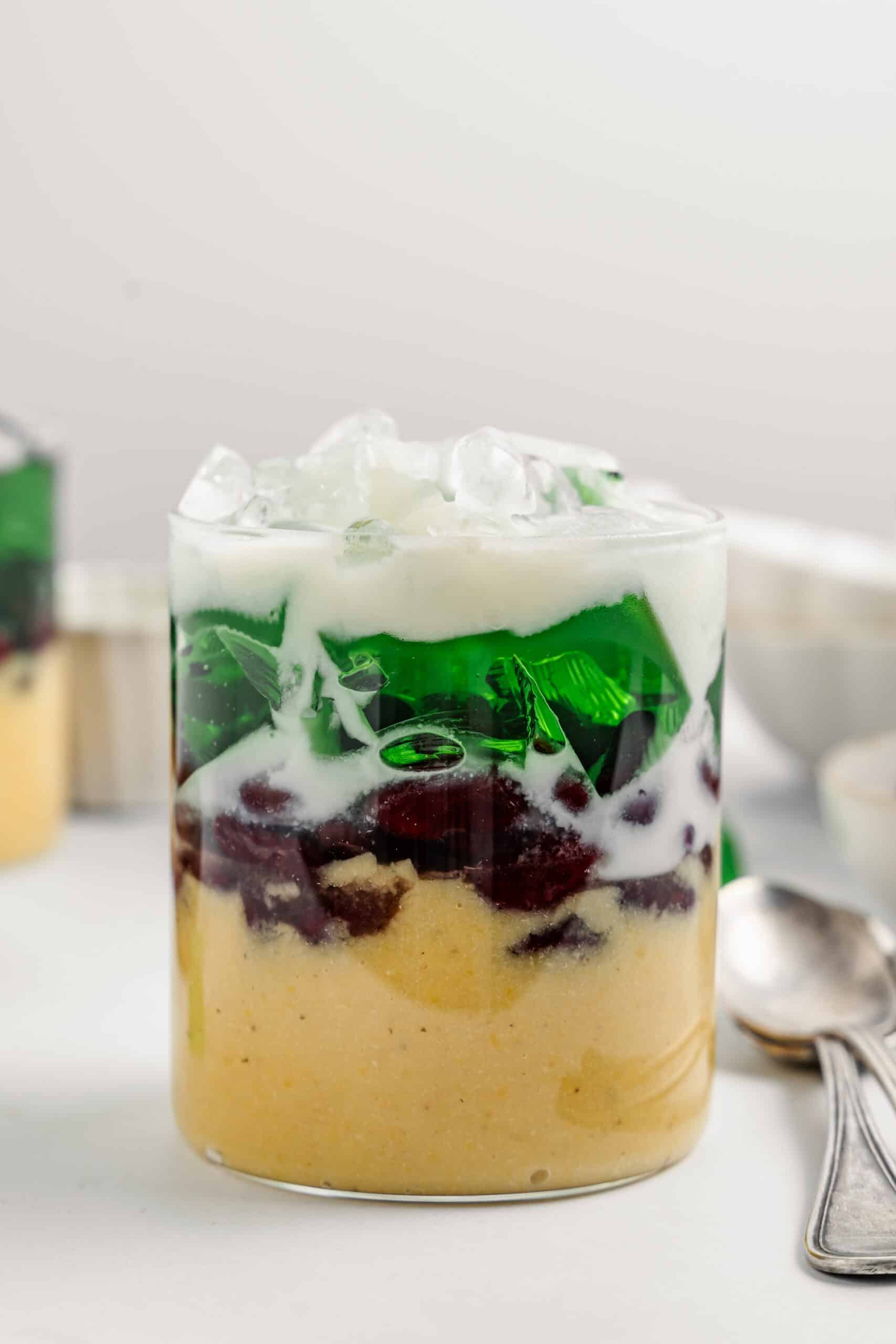
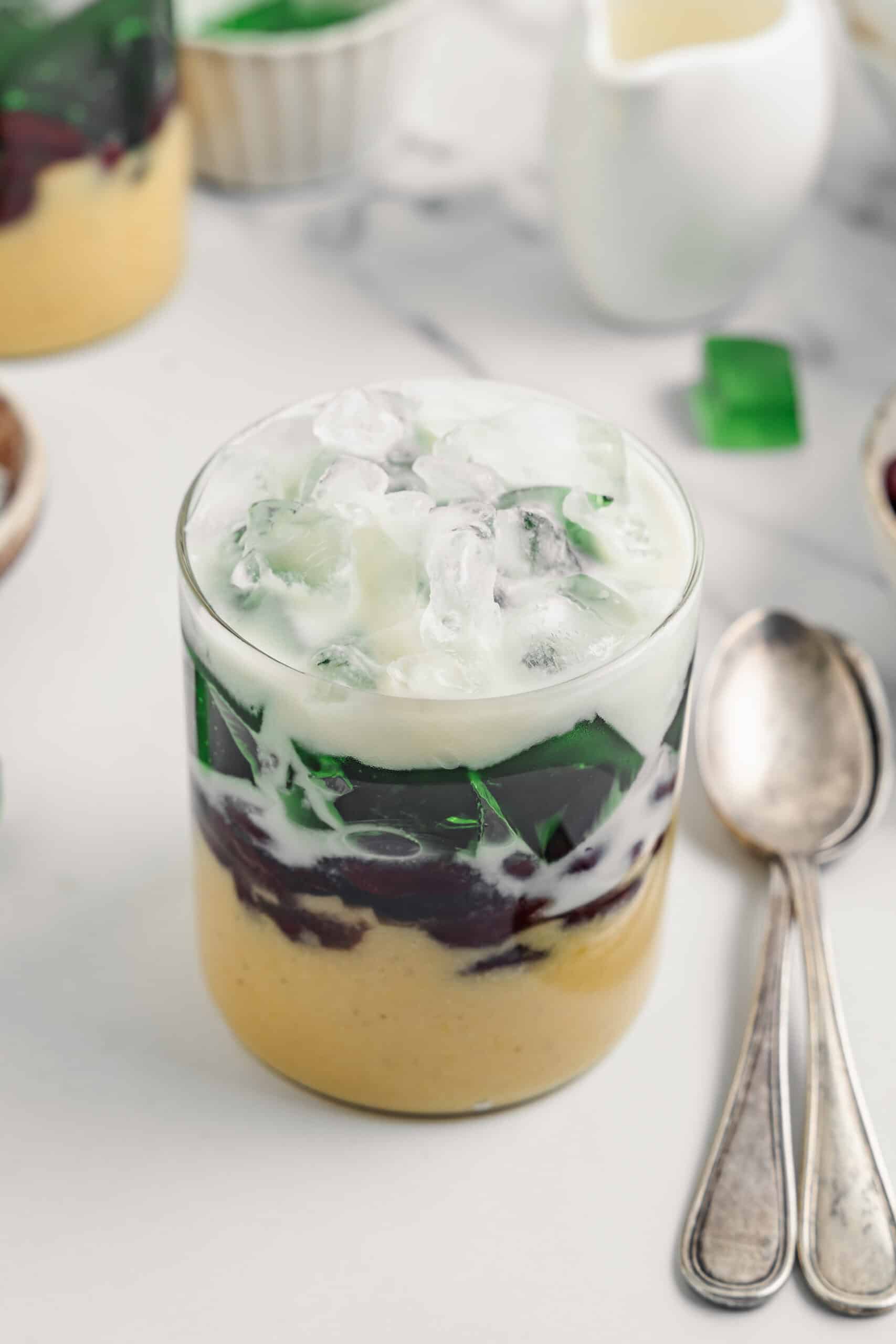
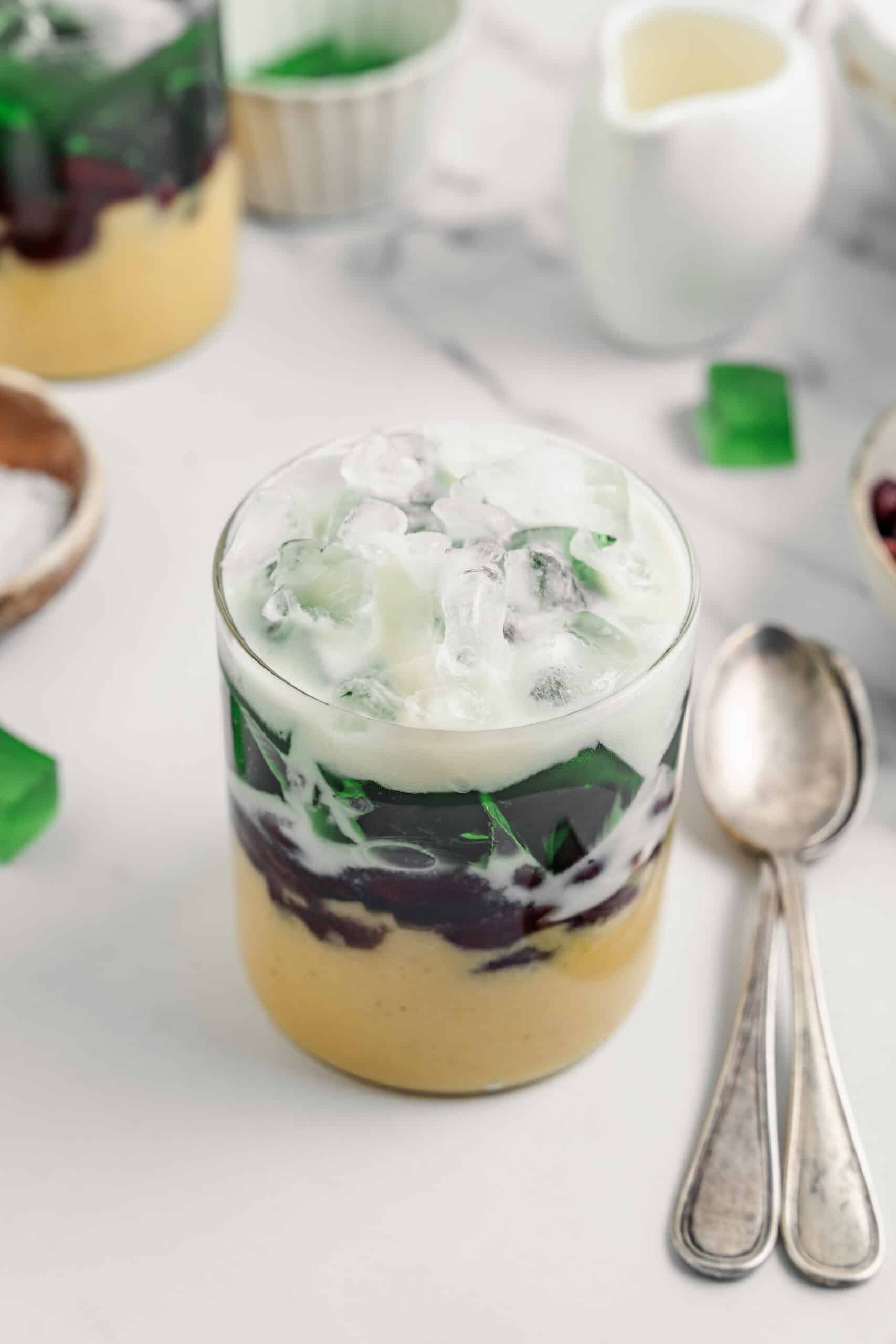
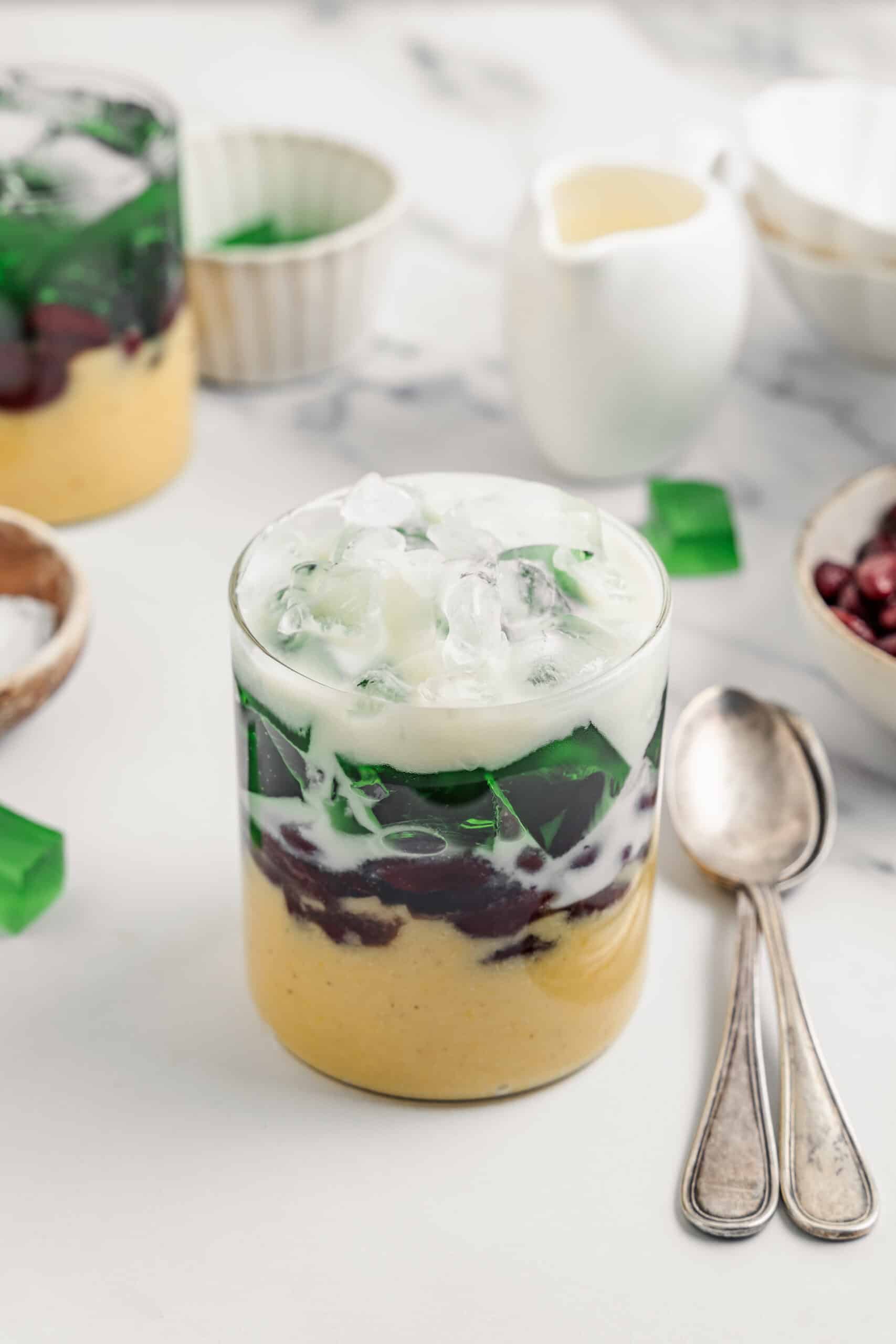
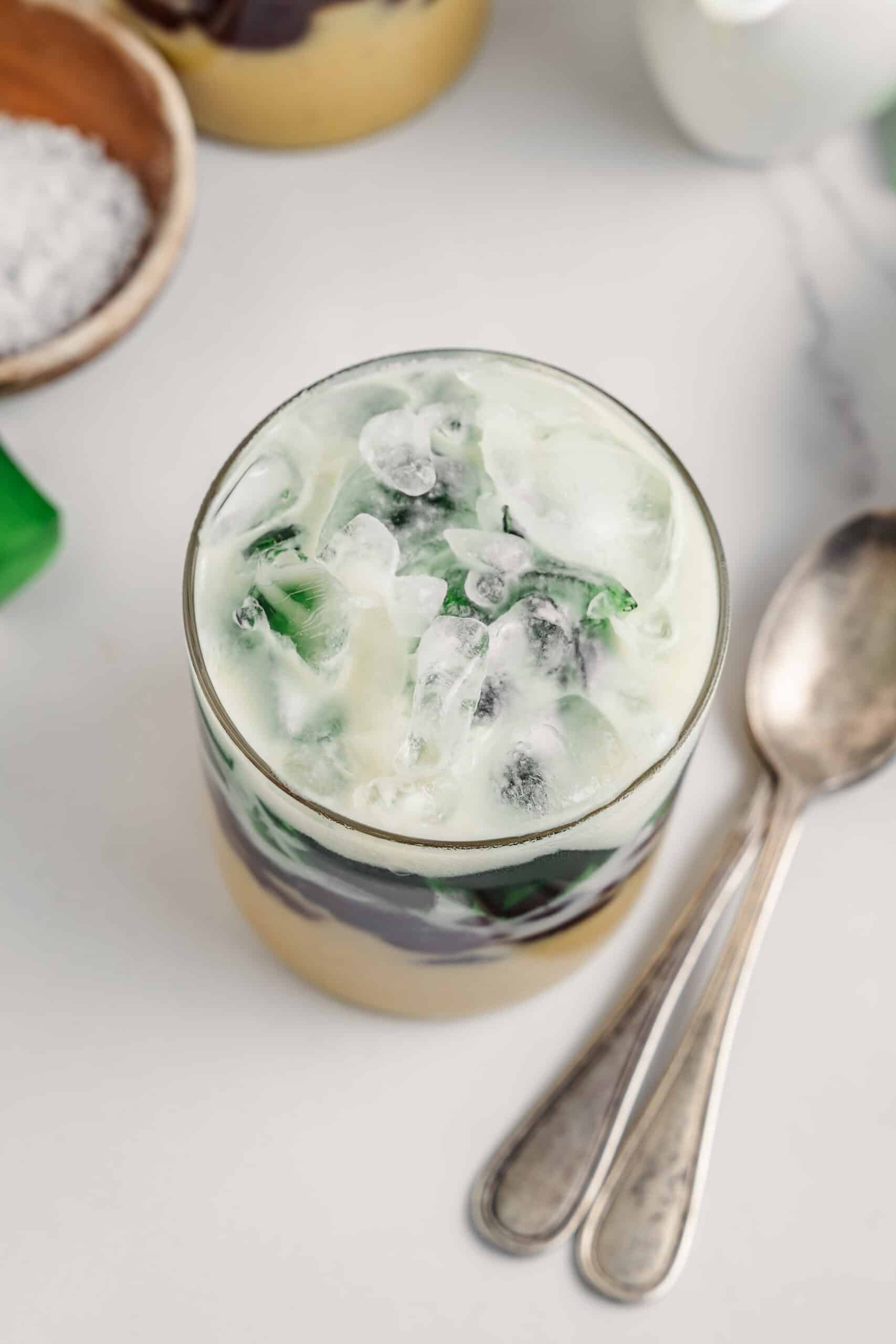
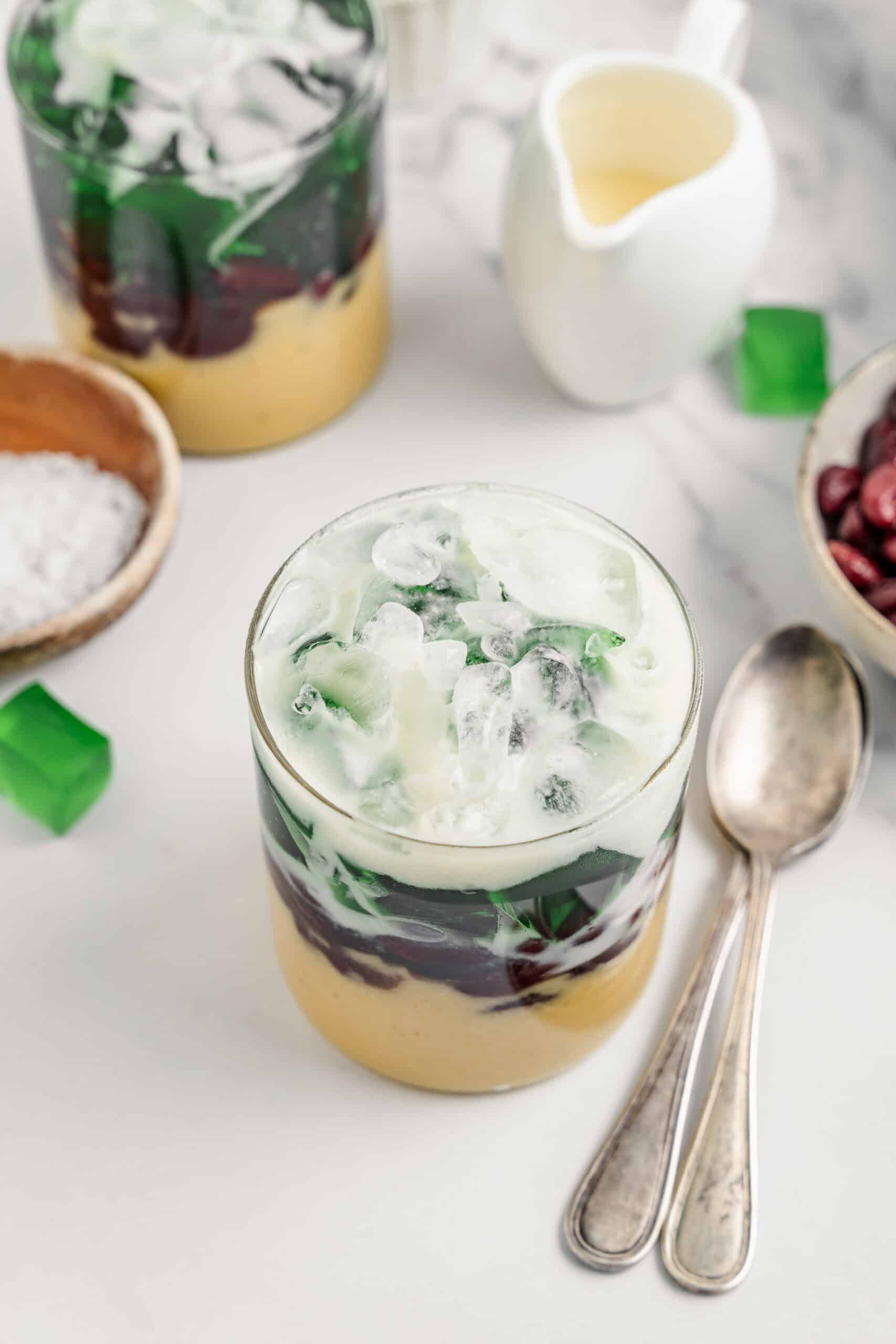
Che ba mau is the Vietnamese three color dessert I make every single summer: sweet mung bean paste, glossy red beans and bright pandan jelly stacked in a glass, buried under crushed ice, then drowned in cold coconut sauce.
I first had che ba mau standing on a footpath in Cabramatta on a 38 degree day, holding a plastic cup that was already sweating through my fingers. The lady handed it over with a long spoon and told me to stir it. I did not stir it. I ate the layers one at a time like a tourist, and by the time I got to the bottom the ice had melted into the coconut milk and turned the whole thing into the best part. That accidental discovery is basically the entire point of the dessert, and it took me an embarrassingly long time to understand that.
It took four goes to get this one photographing the way I wanted. My first attempt had gorgeous flavour and looked like swamp water, because I assembled the glasses an hour before the shoot and the red bean liquid bled straight down through the mung bean layer. The second batch had jelly that collapsed the moment ice touched it, which is what happens when you use gelatin instead of agar agar. Batch three was grainy. Batch four is the one below, and the trick turned out to be almost entirely about temperature, timing and assembling at the very last second. Everything else is genuinely easy.
What Is Che Ba Mau?
Che ba mau translates literally as “three color dessert”, and it is exactly what it sounds like: three distinct sweet layers served cold in a glass. The classic combination is a thick yellow mung bean paste on the bottom, sweetened adzuki red beans in the middle, and bright green pandan jelly on top, all crowned with crushed ice and a pour of salted coconut sauce. It belongs to the enormous Vietnamese family of desserts called che, which covers everything from warm bean puddings to icy drinks.
What makes che ba mau special is that it is a texture dessert first and a sweet dessert second. You get the soft grain of the mung bean, the whole yielding red beans, the springy squeak of agar jelly, the crunch of ice and the round richness of coconut milk, all in one spoonful. It is only lightly sweet by dessert standards, which is why it works so well in real heat. And because there is not a drop of dairy or egg anywhere in it, che ba mau is naturally vegan without anyone having to try.
Where Che Ba Mau Comes From
Che ba mau is Southern Vietnamese street food, most strongly associated with Saigon, where che carts and che shops sell dozens of variations side by side in a row of glass tubs. The three color version became the poster child of the family because it photographs so well and because the ingredients are cheap, shelf stable and available year round. Mung beans, adzuki beans and agar are pantry staples across Southeast Asia.
If it looks familiar, that is because half of Southeast Asia has a cousin of it. Malaysian and Singaporean cendol, Indonesian es campur and Filipino halo halo all run on the same logic: sweet cooked things at the bottom, ice on top, coconut milk over everything, stir before eating. Vietnamese cooks in Australia and the United States carried che ba mau with them, which is why you find it in Cabramatta and Little Saigon in almost exactly the form it takes in Ho Chi Minh City.
How to Make Che Ba Mau
You are making four small things and then stacking them. The red beans get simmered until tender and glazed in sugar. The mung beans get steamed soft and mashed with coconut milk into a paste thick enough to hold a spoon upright. The pandan layer is just agar agar, water, sugar and pandan boiled together and chilled until firm, then cut into strips. The coconut sauce is coconut milk warmed with sugar and a pinch of salt.
None of those four steps is difficult and none of them needs equipment beyond a saucepan and a whisk. The only genuine skill in the whole recipe is patience: every component must be completely cold before it goes into the glass, and the glass must be assembled within a minute or two of serving. Warm mung bean paste will slump. Warm jelly will weep. Assembled early, the layers bleed into each other and you lose the three colors that give the dessert its name. Like my Vietnamese coconut coffee jelly, this is a recipe where the fridge does more of the work than the stove does.
Che Ba Mau At A Glance
| Serves | Prep | Cook | Chill | Total |
|---|---|---|---|---|
| 4 | 30 minutes | 40 minutes | 2 hours plus | About 3 hours 30 minutes |
Add overnight soaking if you are starting from dried red beans. Canned sweetened red beans skip that step completely and cut the whole recipe down to about 45 minutes of hands on work.
Ingredients
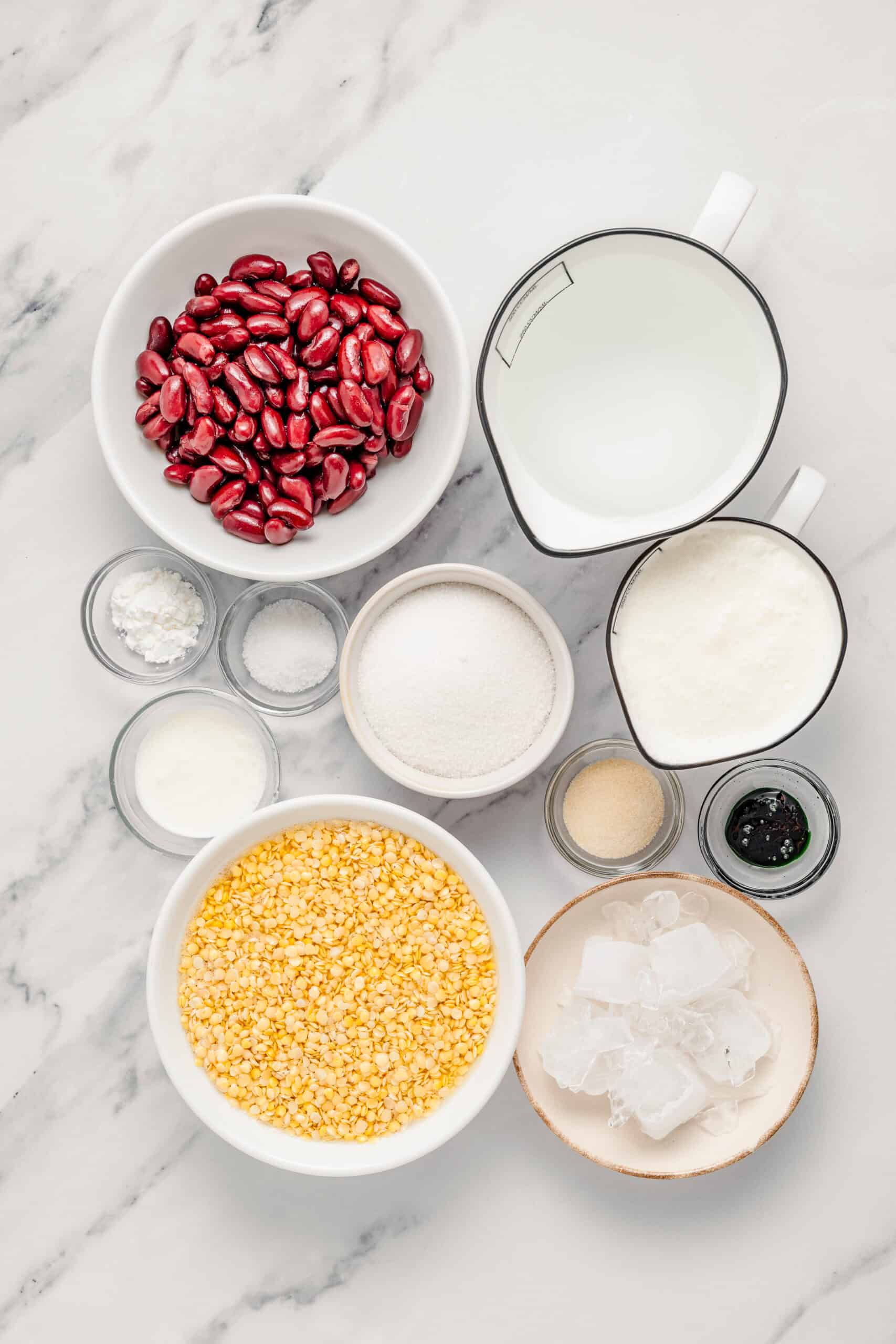
Quantities live in the recipe card at the bottom of the post. Here is what each component is actually doing, because knowing that makes substitutions much easier.
For The Red Bean Layer
- Dried adzuki beans: the small dark red beans that give the middle layer its colour and its whole, yielding bite. Soaking them overnight cuts the simmering time roughly in half and helps them cook evenly instead of splitting.
- Granulated sugar: added after the beans are already tender, never before. Sugar added early keeps the skins tough, so the beans stay chalky no matter how long you cook them.
- Salt: a pinch, but it is doing real work. Without it the red bean layer tastes flat next to the coconut sauce.
For The Mung Bean Layer
- Split skinned mung beans: sold as mung dal, these are the pale yellow split beans, not whole green mung beans. They cook to a soft, floury texture that mashes into a paste. Whole green mung beans will not do this.
- Coconut milk: a couple of tablespoons stirred into the hot mash makes the paste rich and spoonable rather than dry and crumbly.
- Sugar and salt: the salt is what stops this layer tasting like plain porridge. Do not skip it.
For The Pandan Jelly Layer
- Agar agar powder: a seaweed setting agent that sets firm at room temperature and stays firm against a mound of ice. This is the single most important ingredient choice in the recipe.
- Pandan extract: the source of both the green colour and that grassy, vanilla adjacent perfume. Fresh or frozen pandan leaves blended with the water and strained will give you a softer, more natural colour and a better flavour if you can get them.
- Water and sugar: the jelly is deliberately lightly sweetened, because it sits under a sweet coconut sauce and above two sweet bean layers.
For The Coconut Sauce
- Full fat coconut milk: the light stuff turns watery the moment it hits ice. Use the thick canned kind and shake it well before opening.
- Cornstarch: optional, and only about a teaspoon. It gives the sauce enough body to cling to the ice instead of running straight to the bottom of the glass.
- Salt: the pinch that turns sweet coconut milk into proper Vietnamese coconut sauce. It is the difference between fine and very good.
Optional: My Favourite Extras That Add A Little Magic
- Toasted coconut flakes: scattered over the top just before serving, they add a nutty crunch that plays beautifully against the soft beans.
- Roasted peanuts, roughly crushed: very common on che carts in Saigon and my personal favourite addition. The salt and the fat cut straight through the sweetness.
- A strip of pandan leaf in the coconut sauce: steeped while the sauce warms and then fished out, it doubles the pandan aroma without touching the colour of the sauce.
- Chewy tapioca pearls: a small handful cooked and cooled gives you a fourth texture, and turns che ba mau into something closer to a full che dessert bowl.
Substitutions: Smart Ingredient Swaps That Still Taste Amazing
- Canned sweetened red beans instead of dried: the single biggest time saver here. Drain them well and use them straight from the tin, and skip the first step of the recipe entirely.
- Matcha instead of pandan: half a teaspoon whisked into the jelly liquid gives you a green layer with a bitter, tea forward flavour. It is genuinely good, just not traditional.
- Store bought pandan jelly: sold in tubs at most Asian grocers, and completely acceptable on a weeknight. Cut it into strips the same way.
- Palm sugar instead of granulated: use it in the coconut sauce for a deeper caramel note. It will tint the sauce beige, which some people love and some people hate.
- Gelatin instead of agar: please do not. It melts on contact with ice and the layer disappears into the glass within a minute.
If you have never cooked with pandan before, my pandan kaya jam is the gentlest possible introduction, and the pandan chiffon cake shows you what it does in a baked recipe.
Steps
Photos are matched to the steps they show, so you can see exactly what each stage should look like before you move on.
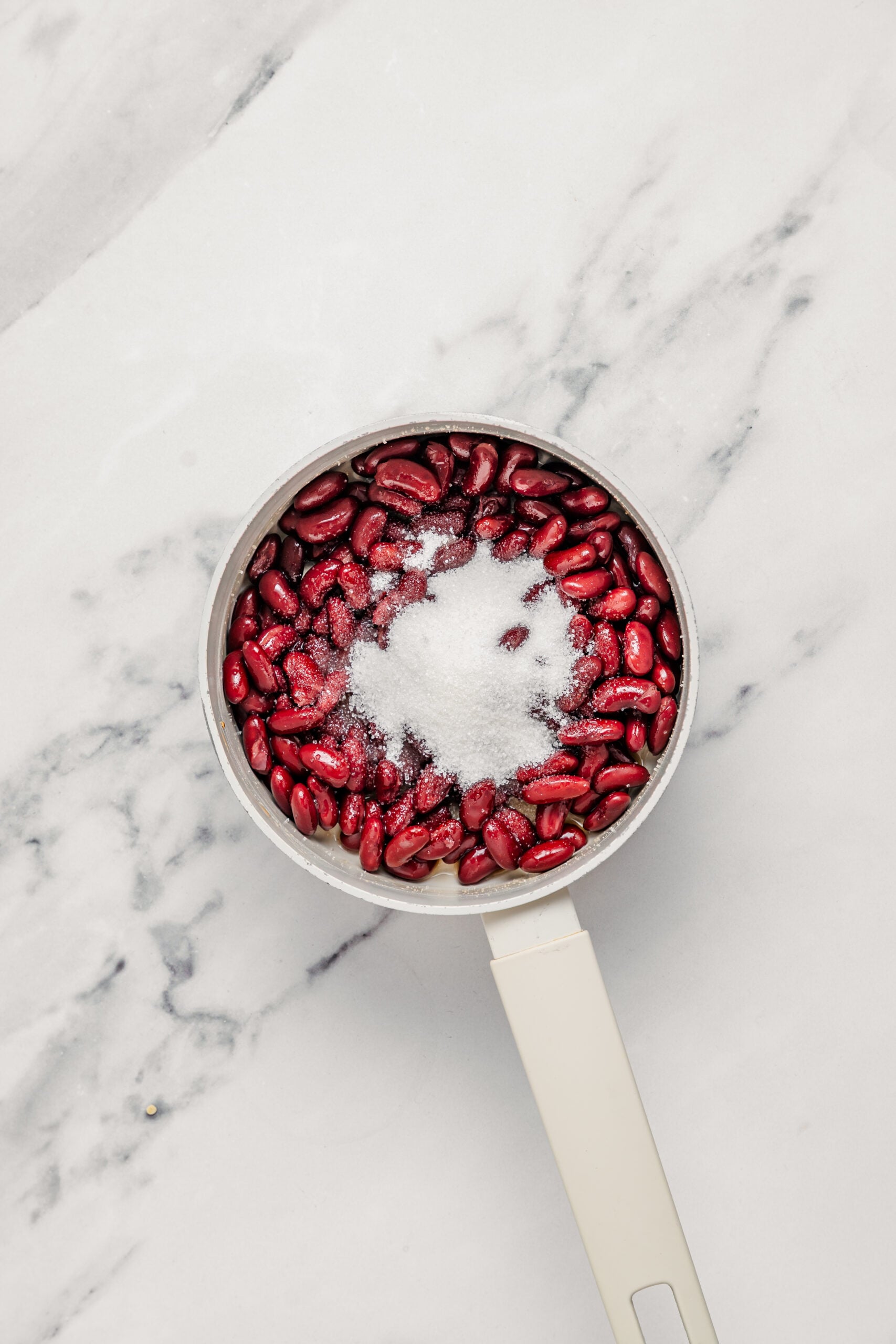
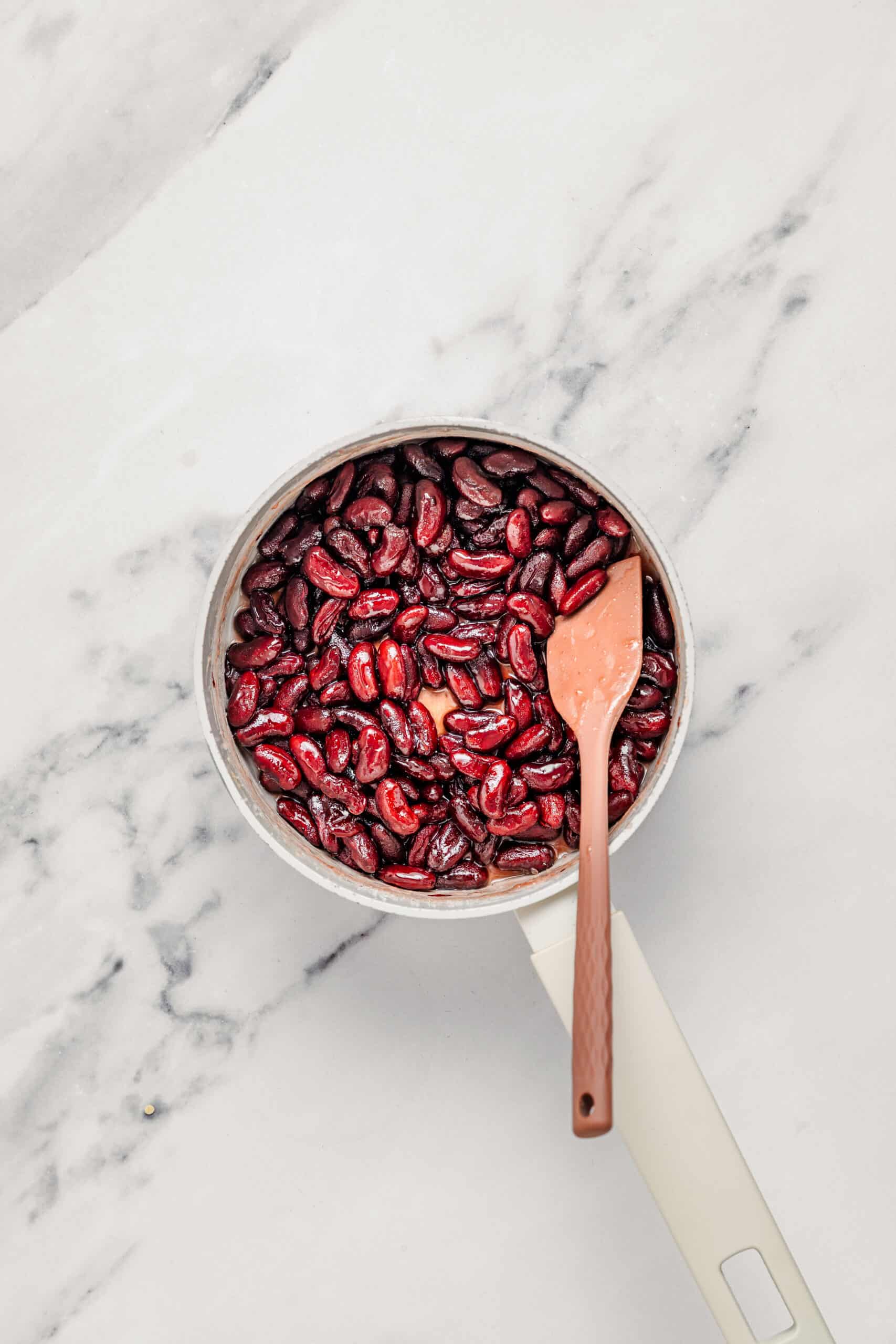
- Drain your soaked adzuki beans, cover them with fresh water and simmer for 45 to 60 minutes until a bean crushes easily against the side of the pan. Drain, return them to the pan, and stir in the sugar and salt.
- Cook for another 3 to 4 minutes, stirring gently, until the beans look glossy and the liquid has reduced to a syrup that just coats them. Take them off the heat and cool completely. Skip both of these steps if you are using canned sweetened beans.
- Drain the soaked split mung beans and steam them, or simmer them with a splash of water, for 15 to 20 minutes. They are ready when a bean squashes to nothing between your fingers with no chalky centre left.
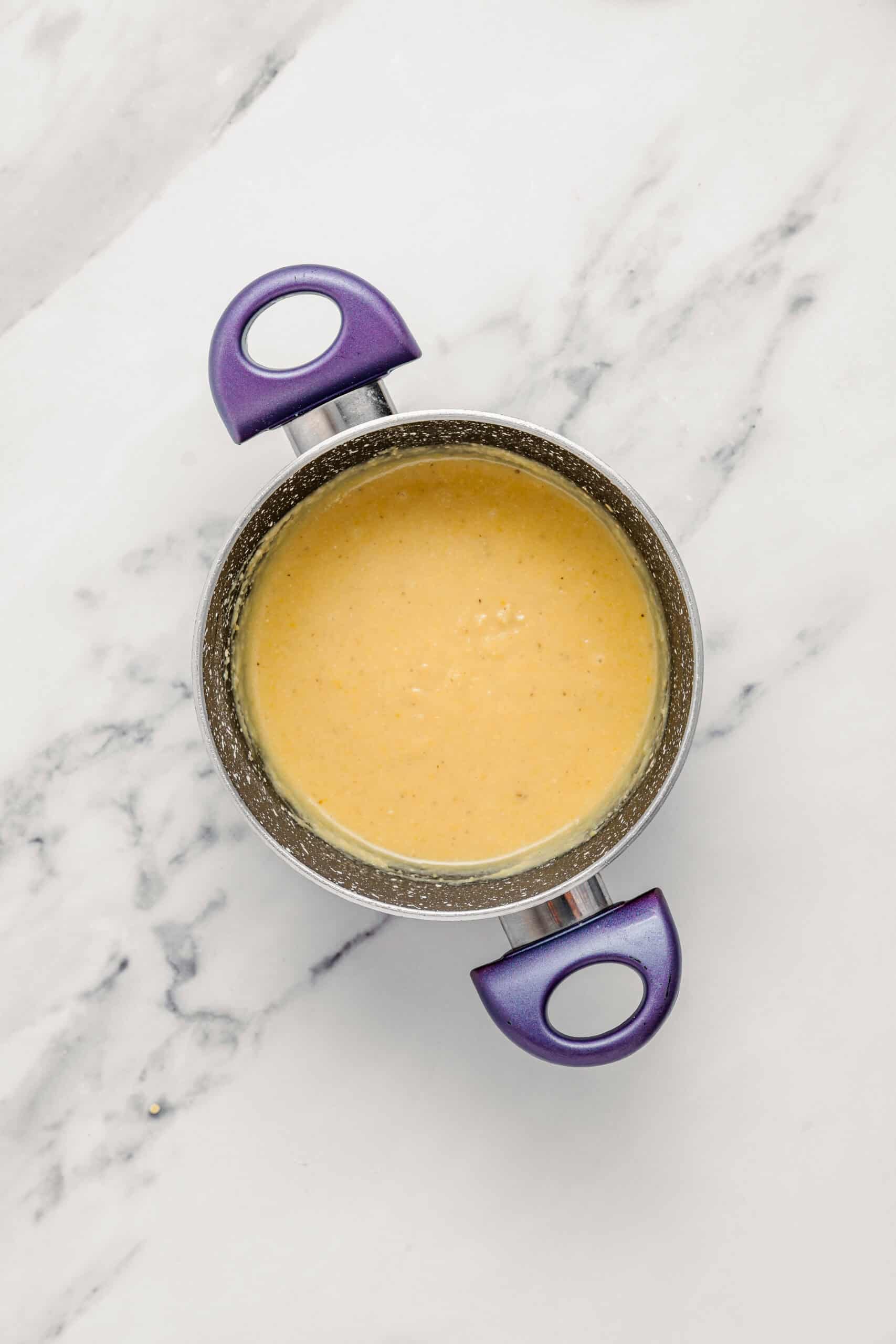
- Mash them while still hot with the sugar, salt and coconut milk until you have a smooth, thick paste that holds its shape on a spoon. Cool completely before it goes anywhere near a glass.
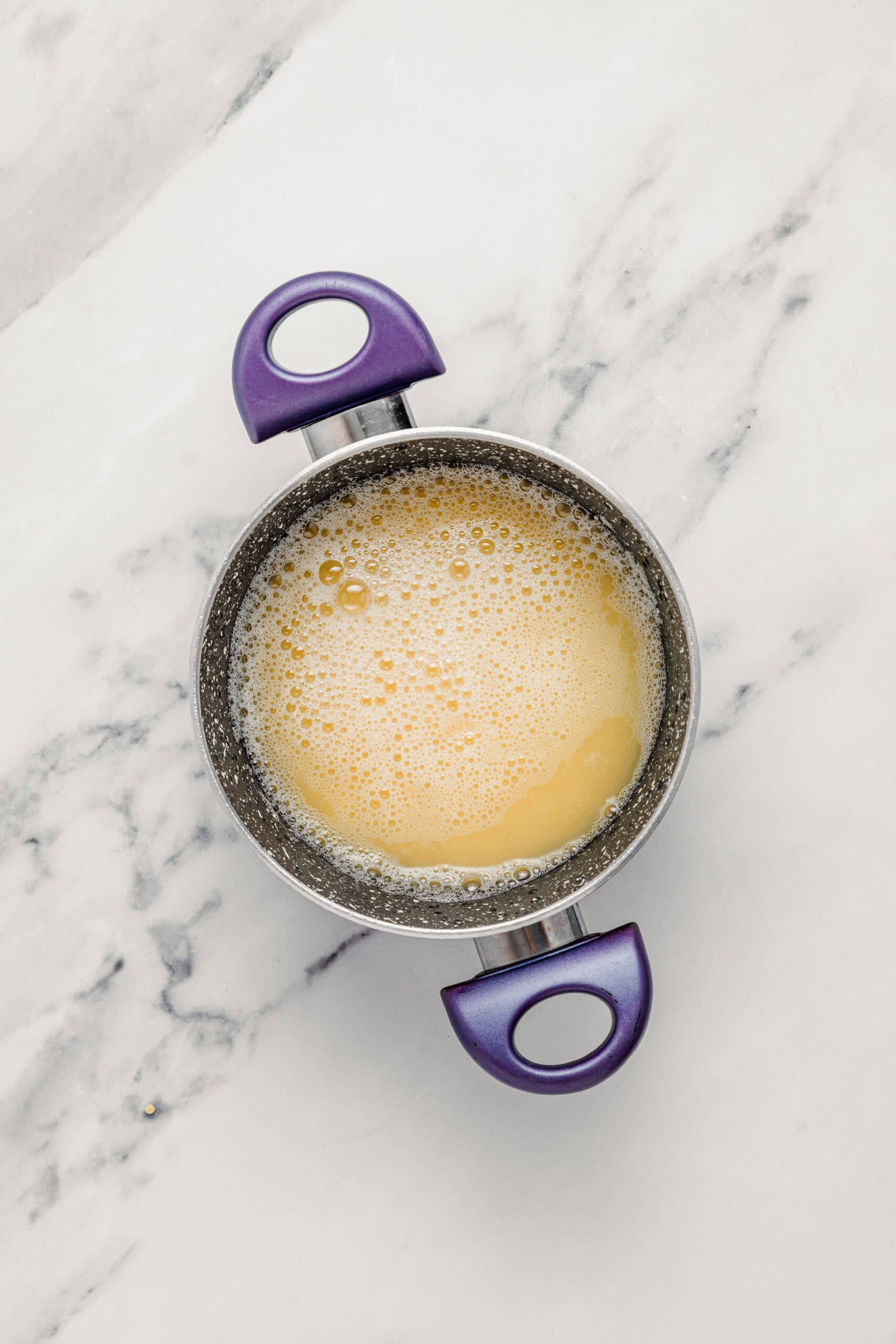
- Whisk the agar agar powder into the cold water in a saucepan and let it sit for 5 minutes to hydrate. This resting step is what stops the agar clumping into rubbery lumps later.
- Bring it to a boil while whisking, then add the sugar and the pandan extract. The liquid will go an alarming bright green. That is correct.
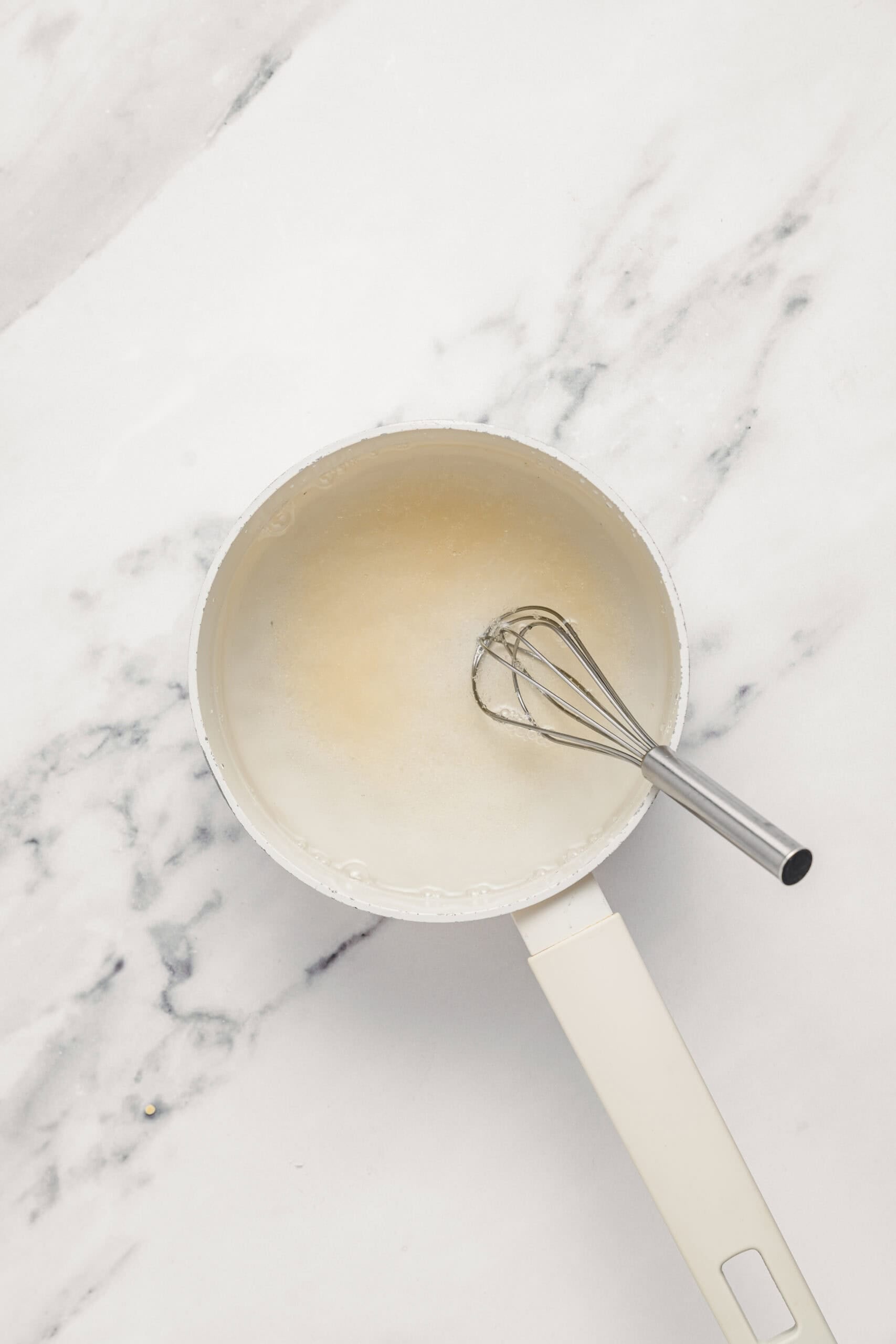
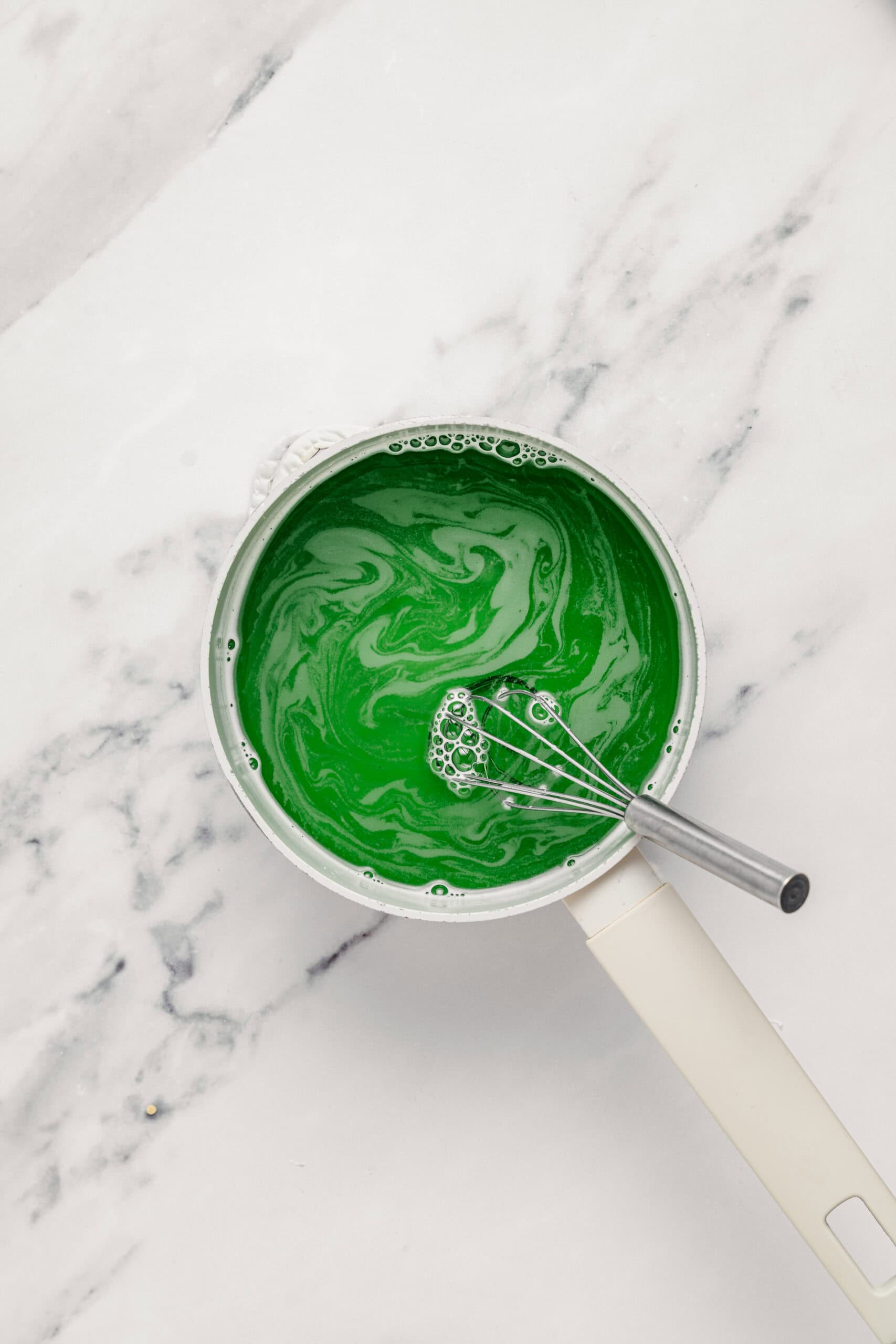
- Boil for a full 2 minutes, stirring, until the agar has completely dissolved. Pour into a shallow dish, cool, then chill for about an hour until firm. Cut it into thin strips or small cubes.
- For the coconut sauce, whisk the coconut milk, sugar and salt together in a clean saucepan, adding the cornstarch slurried in a little cold water if you want it thicker.
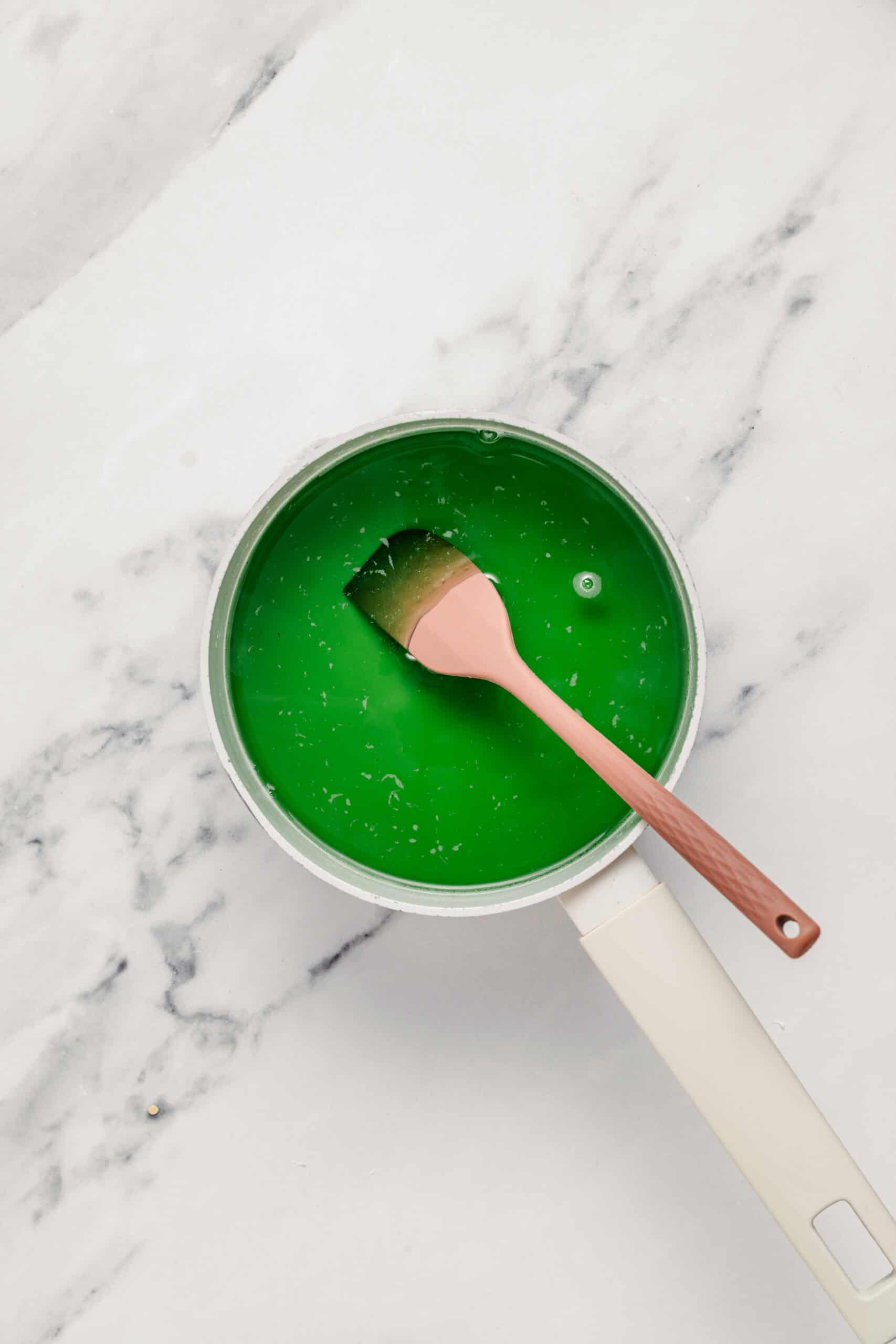
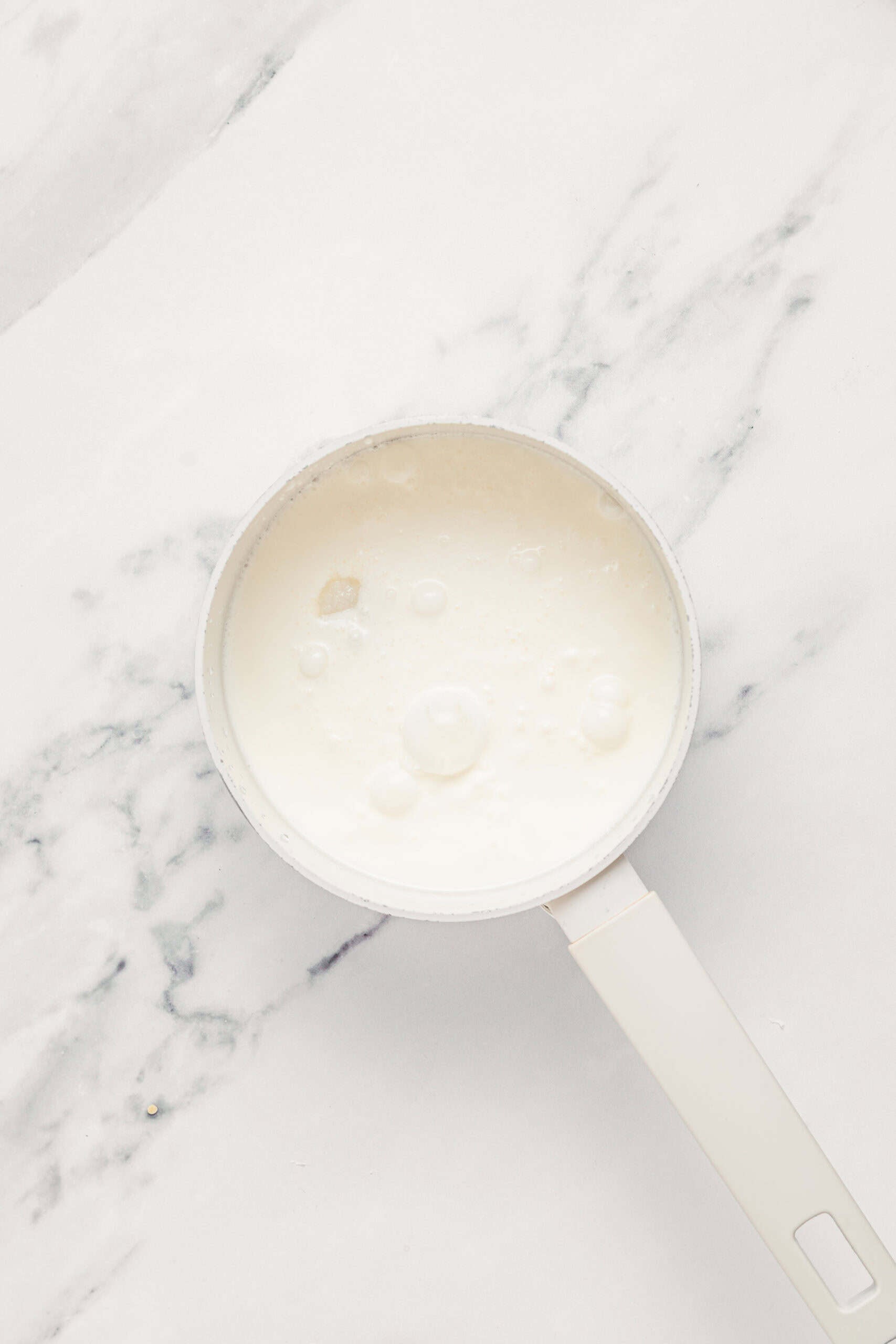
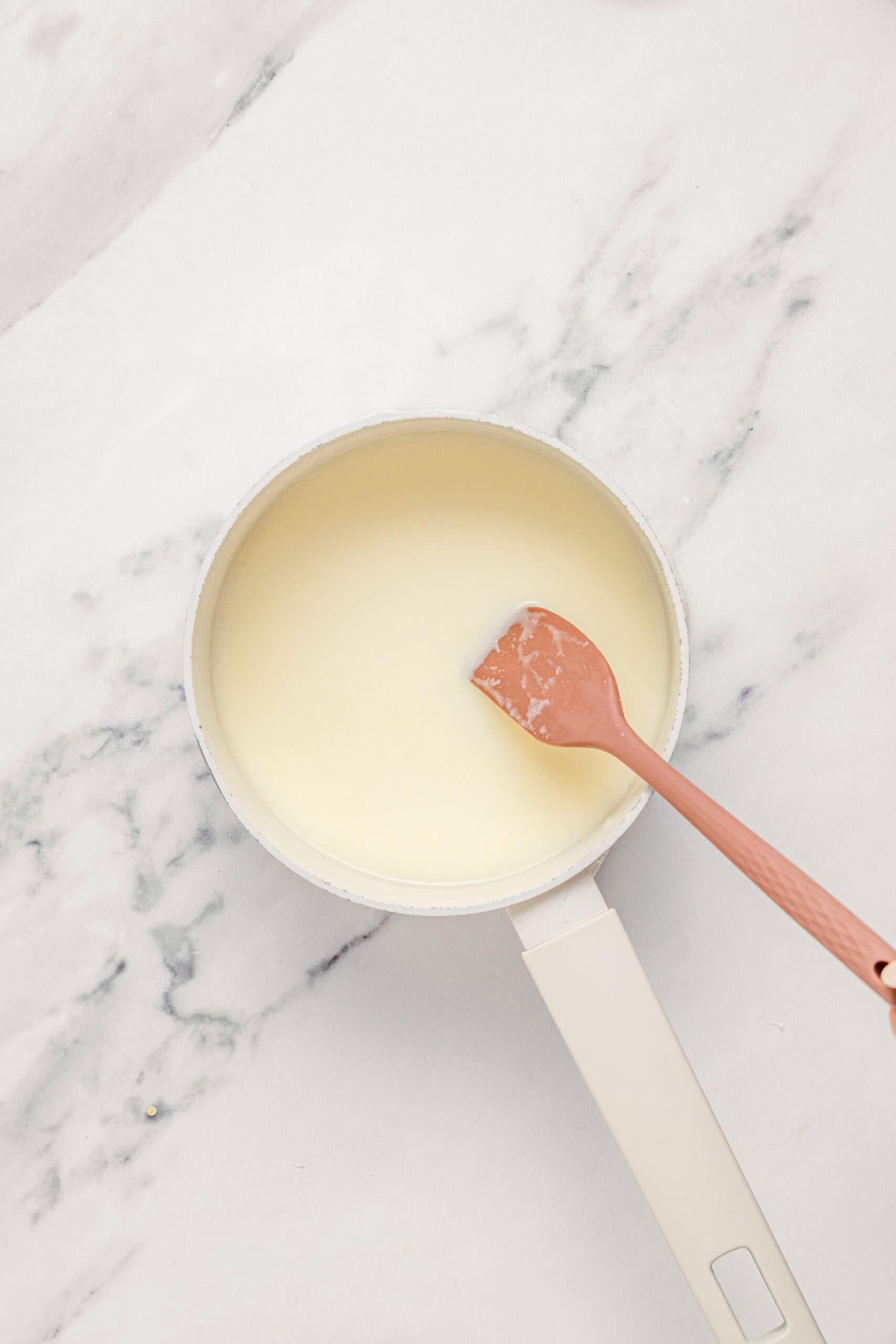
- Warm the sauce over medium heat for 3 to 4 minutes until the sugar has dissolved and it just barely thickens. Do not let it boil hard or the coconut milk can split. Cool it completely, then chill.
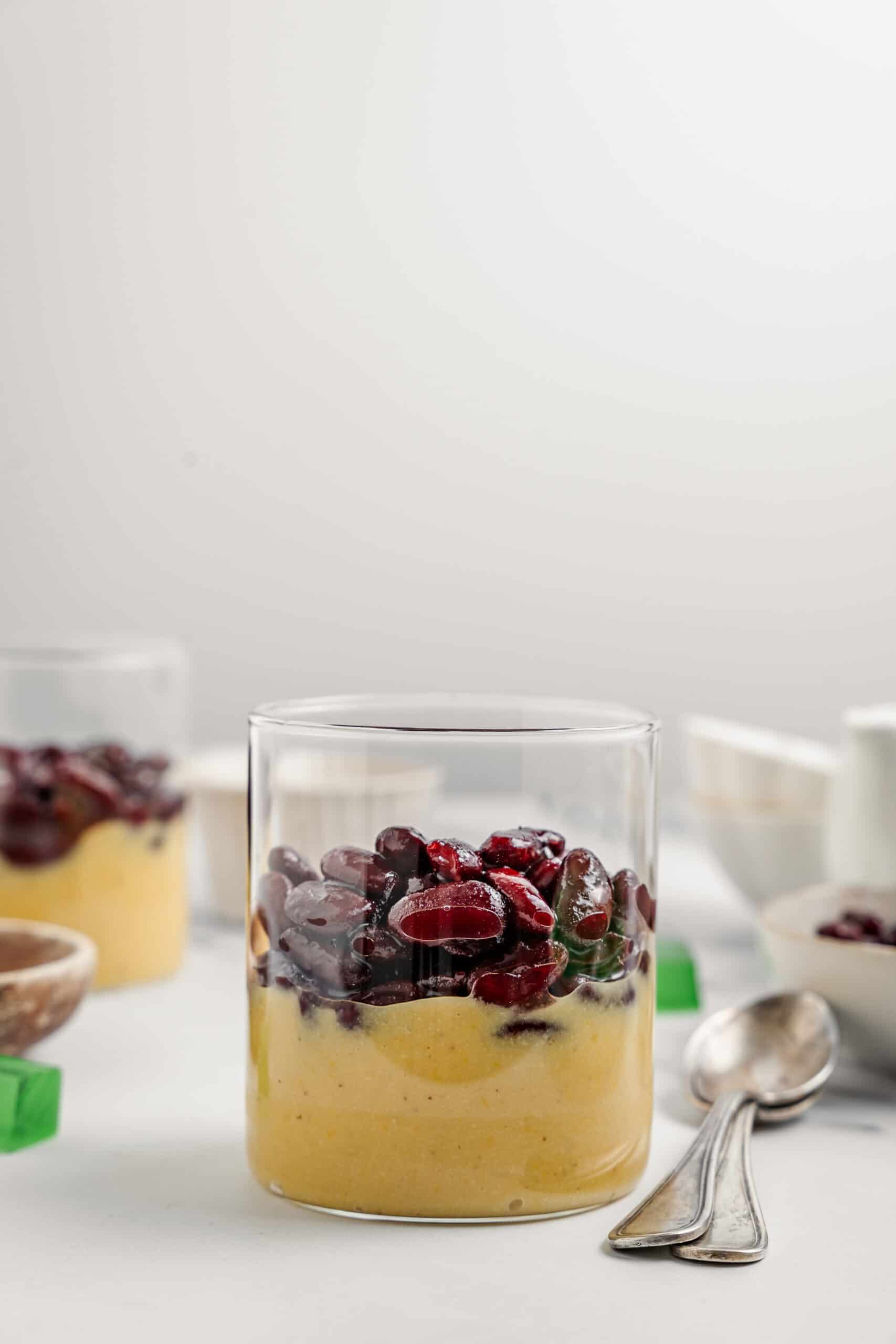
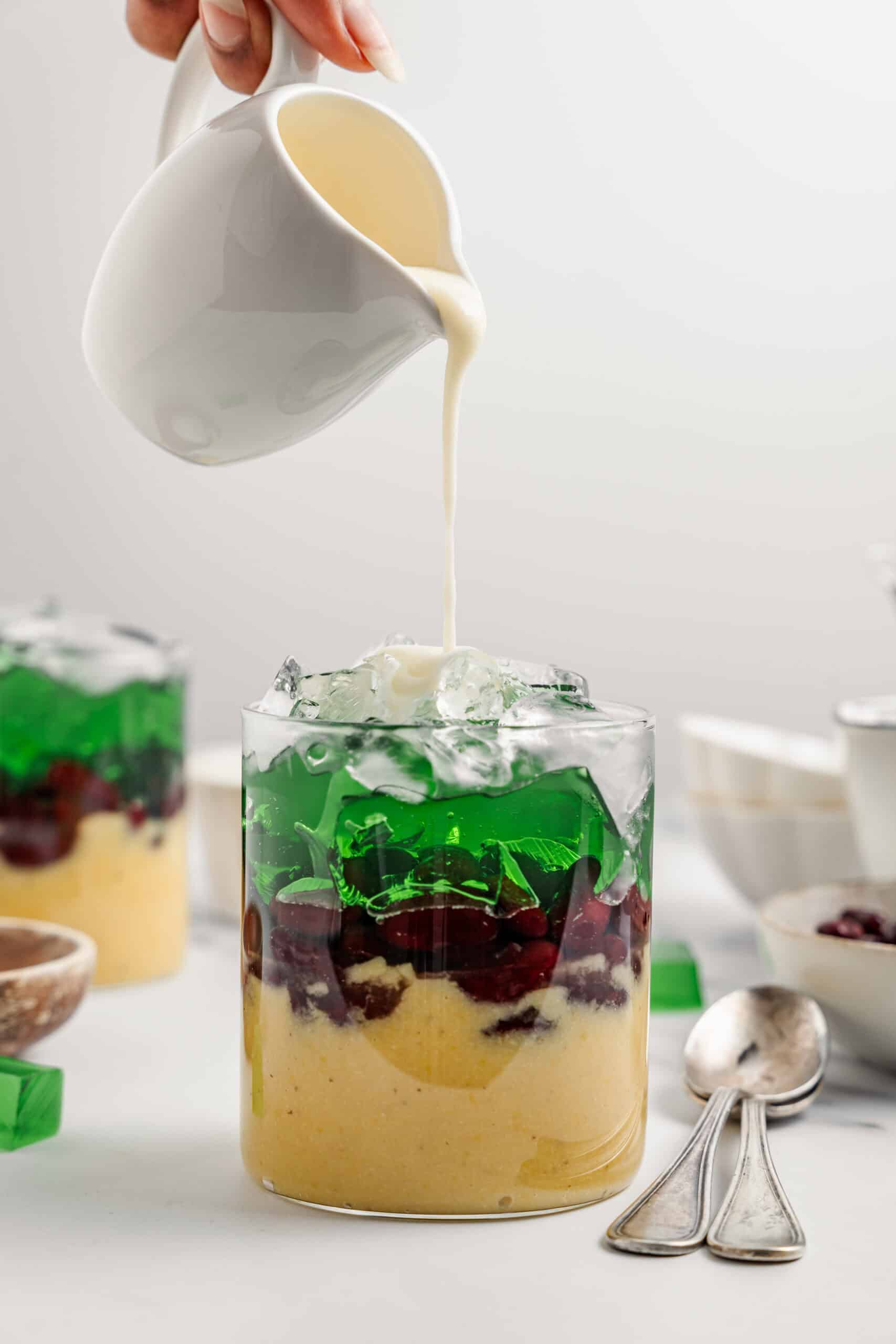
- To assemble, spoon a layer of cold mung bean paste into the bottom of each tall glass, then add a layer of the sweetened red beans on top. Press each layer flat against the glass with the back of a spoon so the bands stay clean and straight.
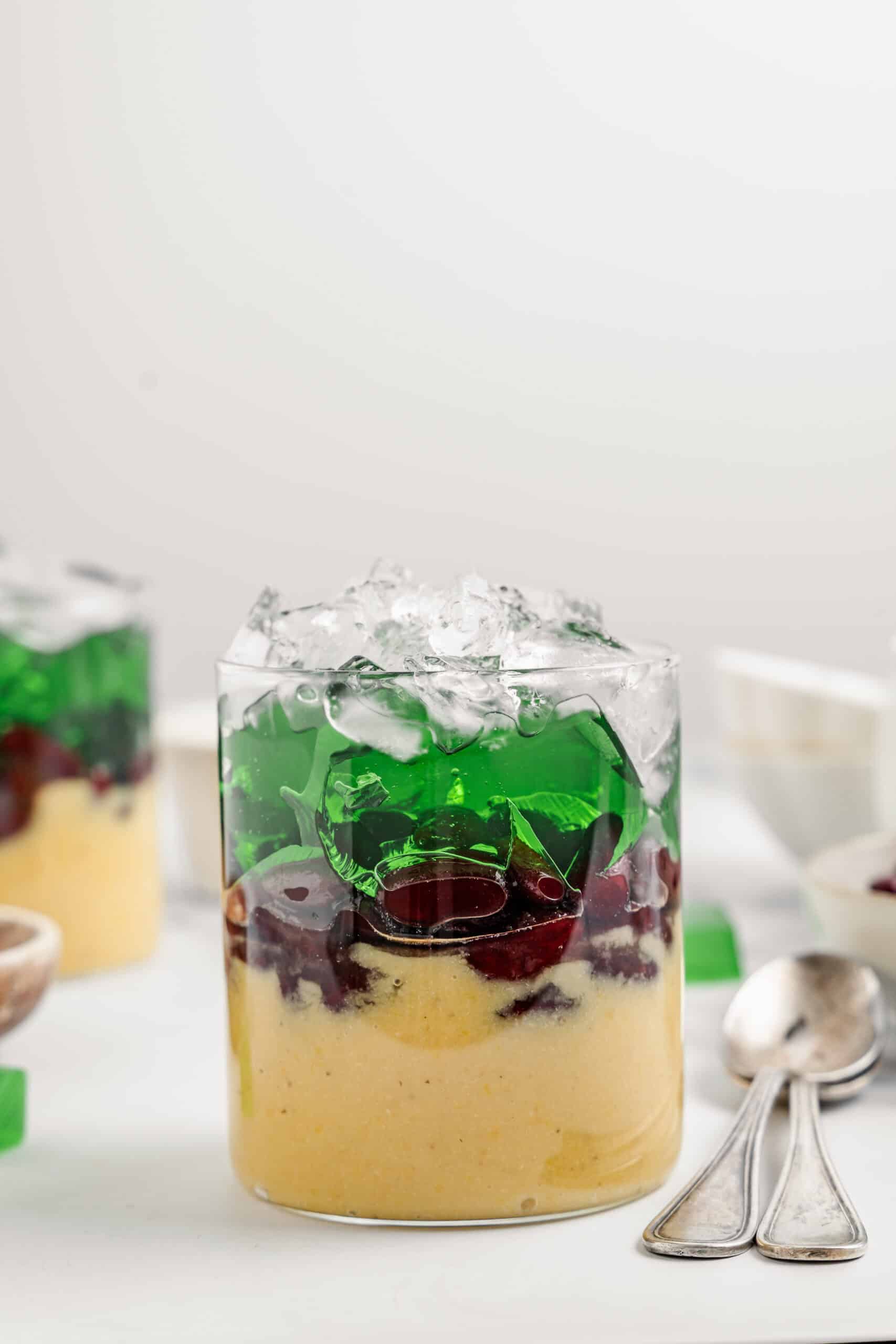
- Add the pandan jelly strips, then pile a generous mound of crushed or finely shaved ice on top. Go higher than feels sensible, because it settles fast.
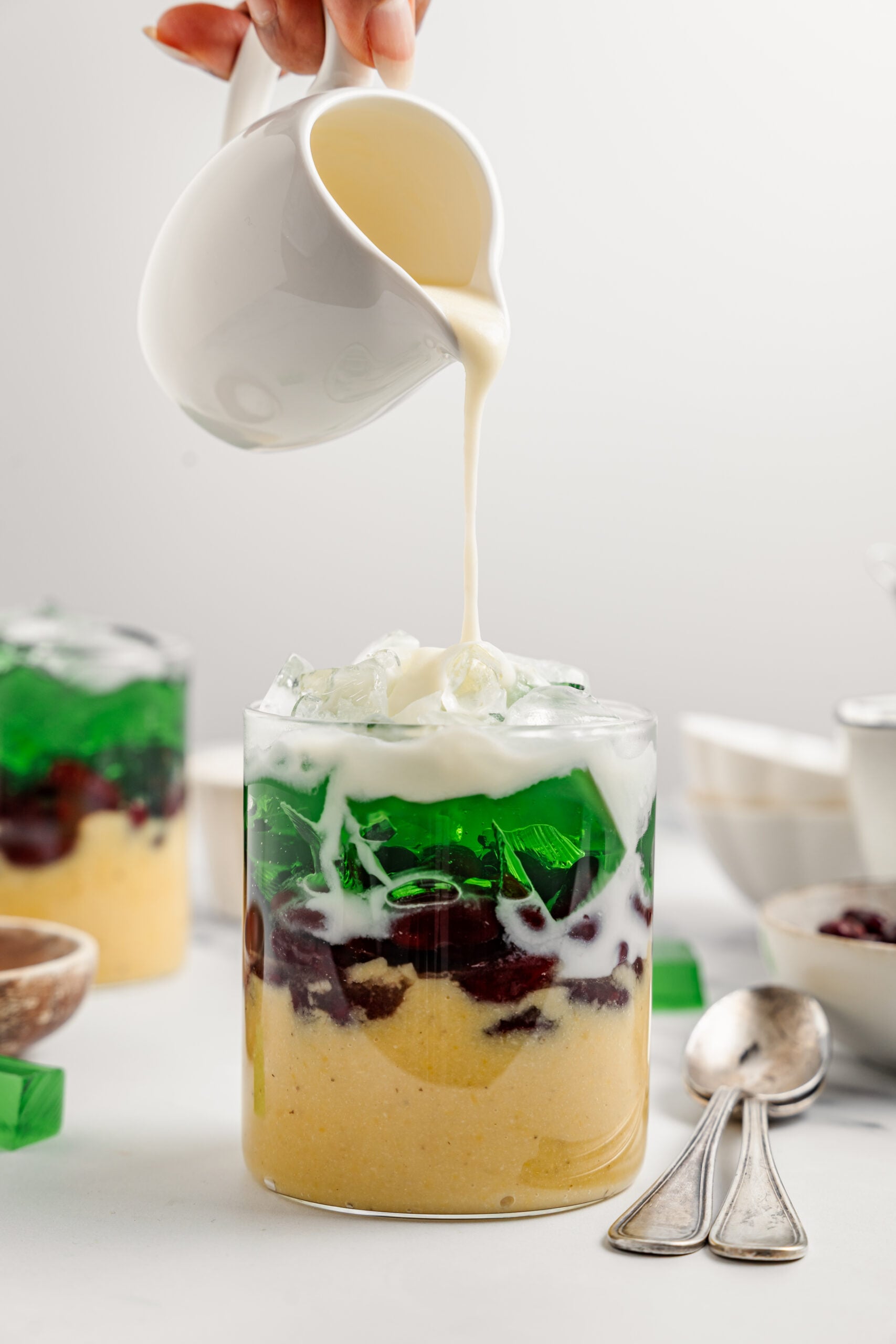
- Pour the cold coconut sauce straight over the ice just before serving, so it runs down through the mound in white ribbons.
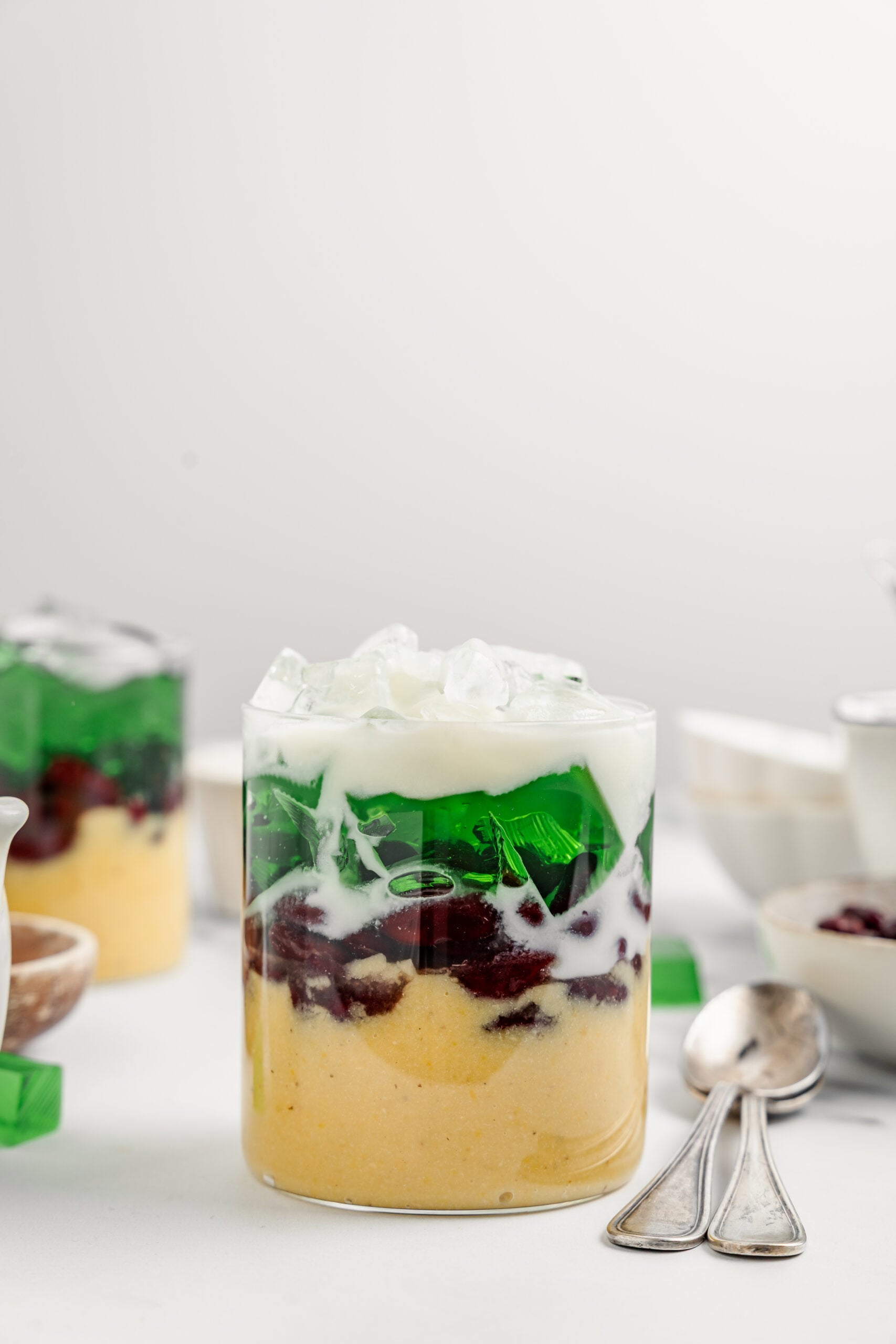
Serve immediately with a long spoon, and tell everyone to stir it before they eat. The dessert is designed to be mixed into one cold, creamy, many textured mess. Resisting that is the only real mistake you can make at the table.
Troubleshooting
Almost every che ba mau problem traces back to one of four things: the setting agent, the bean texture, the temperature, or the timing of assembly. Here is what each failure looks like and how to fix it.
| Problem | Why it happened | How to fix it |
|---|---|---|
| Jelly will not set | Too little agar, or it did not boil for a full 2 minutes | Reboil the liquid with a little more agar and give it a proper 2 minute boil |
| Jelly dissolves on the ice | Gelatin was used instead of agar agar | Remake with agar. Gelatin melts at fridge temperature and cannot survive ice |
| Grainy mung bean layer | The beans were undercooked before mashing | Return the mash to the pan with a splash of water and cook until fully soft, then mash again |
| Muddy, blended layers | Assembled too far ahead, or components were still warm | Chill everything hard and assemble no more than 2 minutes before serving |
| Coconut sauce sinks straight down | The sauce is too thin | Add a teaspoon of cornstarch slurry and rewarm briefly to give it body |
| Beans taste flat | Salt was left out of the bean layers | Add a pinch to each layer. Sweet bean pastes need salt to taste like anything |
Tips For The Best Che Ba Mau
Chill Every Component Separately And Completely
This is the difference between a photograph and a puddle. Every one of the four components must be properly cold before it touches a glass, because a warm mung bean layer will slump under the weight of the beans above it and a warm jelly will weep liquid into everything. I make all four components the day before and keep them in separate containers in the fridge overnight. Assembly then takes about ninety seconds.
Press Each Layer Flat Against The Glass
Spoon the layer in, then use the back of a teaspoon to press it gently but firmly into the base and out to the sides of the glass. Air pockets against the glass wall are what make homemade che ba mau look messy, and they are entirely avoidable. Straight sided glasses give much cleaner bands than tapered ones, and a narrow glass makes the layers look thicker and more dramatic than a wide one.
Crush Your Ice Properly, Do Not Just Use Cubes
Whole ice cubes leave big gaps that the coconut sauce falls straight through, and they are miserable to eat around. You want fine, snowy ice that holds the sauce suspended in it. A blender pulsed a few times works, so does a tea towel and a rolling pin, and if you make a lot of iced desserts a cheap manual ice shaver is genuinely worth owning. The same rule applies to my mango bingsu, where the texture of the ice is the entire dessert.
Taste The Coconut Sauce Cold, Not Warm
Cold blunts sweetness quite dramatically, so a coconut sauce that tastes perfectly balanced in the warm pan will taste thin and underseasoned by the time it hits the ice. Chill a spoonful in the freezer for two minutes and taste that before you decide it is finished. Nine times out of ten it needs a little more sugar and a little more salt than you think.
Stir it. The whole dessert is built to be mixed into one cold creamy mess, and the layers are there so the mixing is a pleasure rather than an obligation.
Catherine
Variations
Che Ba Mau With Tapioca Pearls
Cook a small handful of small tapioca pearls until translucent, rinse them cold, and add them as a fourth layer between the red beans and the jelly. They bring a chewy, slippery texture that makes the dessert feel much closer to a full Saigon che shop bowl. Keep them in a little of their cooking syrup so they do not stick together in the fridge.
Matcha Three Color Dessert
Swap the pandan for half a teaspoon of matcha whisked into the agar liquid before boiling. You get a softer, greyer green and a bitter tea note that plays surprisingly well against the sweet mung bean. This is the version I make when I have run out of pandan, and honestly a few people prefer it.
Che Ba Mau With Coconut Jelly
Make a second batch of agar jelly using coconut milk instead of water, set it in a shallow tray, and cube it. Alternating green pandan jelly and white coconut jelly gives you four visible colours in the glass and adds another creamy note. It does take an extra hour of chilling, so plan for it.
Warm Winter Che
Skip the ice entirely, warm the coconut sauce, and serve the beans and jelly in a bowl with the hot sauce poured over. It stops being che ba mau in the strict sense and becomes something closer to a bowl of warm che, which is exactly what Vietnamese dessert shops sell when the weather turns. Lovely in July if you are in the southern hemisphere like me.
Serving Suggestions
Serve It In Clear Glass, Always
The whole appeal of a three color dessert is that you can see the three colors, so opaque cups defeat the point entirely. Straight sided tumblers, small mason jars and even tall wine glasses all work. Give everyone a long handled spoon or an iced tea spoon so they can reach the mung bean layer at the bottom without wearing the coconut sauce.
What To Serve It After
Che ba mau is light, cold and only moderately sweet, which makes it a good finish to a heavy, salty, herby meal. I serve it after bun cha, grilled pork vermicelli bowls, or anything involving a lot of fish sauce and chilli. It also works beautifully as a mid afternoon snack on its own, which is honestly how it is eaten most often in Vietnam.
Building A Vietnamese Dessert Table
If you are feeding a crowd, set out the four components in bowls with a tub of crushed ice and a jug of coconut sauce and let everyone build their own. It turns dessert into an activity, it solves the assemble at the last minute problem completely, and nobody ends up with a layer they do not like. A jug of iced Vietnamese coffee sits very happily on the same table.
How To Store Che Ba Mau
Store the components, never the assembled dessert. A finished glass of che ba mau has a shelf life of about ten minutes before the ice melts and the layers bleed, and there is no recovering it. Keep the mung bean paste, red beans, pandan jelly and coconut sauce in four separate airtight containers in the fridge, where they will all hold for 2 to 3 days.
The mung bean paste firms up considerably when cold, so let it sit at room temperature for ten minutes and stir it before spooning it in, or loosen it with a teaspoon of coconut milk. The pandan jelly is the one component that genuinely improves after a night in the fridge, since it firms up and cuts into much cleaner strips. Do not freeze any of it: the agar goes spongy and weeps water when it thaws, and the mung bean paste turns grainy. If you have leftover sweetened red beans, they are excellent in steamed red bean buns.
Common Mistakes To Avoid
Using Gelatin Instead Of Agar Agar
This is the mistake that ruined my second test batch and it is the one I see most often. Gelatin sets soft and melts at around body temperature, so the moment it meets a mound of ice and a warm room it starts collapsing, and within a minute your green layer is a green puddle. Agar agar sets much firmer, holds at room temperature and keeps its clean cut edges in the glass. They are not interchangeable here.
Assembling The Glasses Too Early
I know the temptation, especially if you are cooking for people. Do not. Even fully chilled, the sugar syrup from the red beans starts migrating down into the mung bean layer within about twenty minutes, and you lose the crisp colour separation that makes the dessert worth looking at. Prep everything, line up the glasses, and assemble while people are still finishing their mains.
Adding Sugar To The Red Beans Too Early
Sugar added at the start of cooking keeps bean skins tough, and no amount of extra simmering will fix it afterwards. Cook the beans in plain water until they are properly tender first, then drain and glaze them with the sugar for a few minutes at the end. The same rule applies to almost every sweet bean paste in Asian baking, including most sweet bean fillings.
Using Whole Green Mung Beans
Whole green mung beans have their skins on and will never mash into a smooth paste, no matter how long you cook them. You need split skinned mung beans, sold as mung dal, which are pale yellow and split in half. Check the packet before you buy: the two look completely different in the bag and completely different in the pot.
Skimping On The Ice
Che ba mau is supposed to be aggressively cold, and a polite scattering of ice will melt into the beans within seconds and leave you with a warm sweet paste. Pile it high, higher than looks reasonable, because it settles as the coconut sauce goes over it. If you want to understand exactly how much ice a shaved ice dessert really needs, read what bingsu actually is and apply the same logic.
Frequently Asked Questions
What does che ba mau mean?
Che ba mau translates directly as three color dessert. Che is the broad Vietnamese word for sweet soups and puddings, and ba mau means three colors, which refers to the yellow mung bean, red adzuki bean and green pandan jelly layers. You will also see it written as che 3 mau on menus in Vietnam and in Vietnamese grocers abroad.
Can I use gelatin instead of agar agar for the pandan jelly?
No, and this is the one substitution I would genuinely talk you out of. Gelatin sets soft and starts melting at around room temperature, so it collapses within a minute of meeting a mound of crushed ice. Agar agar sets much firmer, holds its shape at room temperature, and cuts into clean strips that survive being stirred through the glass.
Is che ba mau vegan?
Yes, completely, and without any substitutions. Every component is plant based: beans, sugar, water, agar agar, pandan and coconut milk. Just check that your agar agar is pure agar rather than a jelly mix that contains gelatin, since a few supermarket setting powders blend the two.
How far ahead can I make che ba mau?
Make all four components up to 2 or 3 days ahead and keep them in separate airtight containers in the fridge. Do not assemble the glasses ahead of time. A finished che ba mau holds its layers for roughly ten minutes before the ice melts and the colours bleed together, so build it while people are still at the table.
Where can I buy split mung beans and pandan extract?
Both are stocked in almost any Asian grocer, and increasingly in the international aisle of large supermarkets. Look for split skinned mung beans sold as mung dal, which are pale yellow and split in half rather than whole and green. Pandan extract sits with the baking essences, usually in a small bottle with a very green label, and a little goes a long way.
Why did my mung bean layer turn out grainy?
The beans were not cooked long enough before mashing. Split mung beans need to be soft enough that one squashes to nothing between your fingers with no chalky centre, which usually takes 15 to 20 minutes of steaming or simmering. If you have already mashed them, return the paste to the pan with a splash of water, cook it a few minutes more, then mash again while it is hot.
Let’s Get Cooking
If you liked this recipe make sure to leave me a comment and rating down below. I’d love to know how it went! Also, don’t forget to tag me on Instagram @catherine.desserts.
Follow me on Facebook, Pinterest, YouTube, and TikTok for more of my baking creations and updates!
Che Ba Mau (Vietnamese Three Color Dessert)
Che ba mau is the Vietnamese three color dessert: sweet mung bean paste, glossy red beans and bright pandan jelly layered in a glass under crushed ice and cold coconut sauce. It is naturally vegan, needs no special equipment, and comes together in one afternoon.
- Prep Time: 30 minutes
- Chill Time: 2 hours
- Cook Time: 40 minutes
- Total Time: 3 hours 30 minutes
- Yield: 4 servings 1x
- Category: Dessert
- Method: Stovetop
- Cuisine: Vietnamese
Ingredients
Red bean layer
- 1/2 cup (100 g) dried adzuki (red) beans, soaked overnight, or 1 cup canned sweetened red beans, drained
- 3 tablespoons granulated sugar
- Pinch of salt
Mung bean layer
- 1/2 cup (100 g) split skinned mung beans (mung dal), soaked 2 hours
- 2 tablespoons granulated sugar
- 1/4 teaspoon salt
- 2 tablespoons coconut milk
Pandan jelly layer
- 1 1/2 cups (360 ml) water
- 1 teaspoon agar agar powder
- 3 tablespoons granulated sugar
- 1/2 teaspoon pandan extract, or a small handful of fresh or frozen pandan leaves, blended and strained
Coconut sauce
- 1 cup (240 ml) coconut milk
- 2 tablespoons granulated sugar
- 1/8 teaspoon salt
- 1 teaspoon cornstarch, optional, for a slightly thicker sauce
To serve
- Crushed or finely shaved ice
Instructions
- If you are starting from dried red beans, drain the soaked beans, cover them with fresh water and simmer for 45 to 60 minutes until they are tender enough to crush against the side of the pan. Drain, return them to the pan with the sugar and salt, and cook for 3 to 4 minutes until glossy. Cool completely. Skip this step entirely if you are using canned sweetened red beans.
- Drain the soaked mung beans and steam them, or simmer them with a splash of water, for 15 to 20 minutes until very soft.
- Mash the hot mung beans with the sugar, salt and coconut milk into a smooth, thick paste. Cool.
- Whisk the agar agar into the water in a saucepan and let it sit for 5 minutes to hydrate. Bring it to a boil, whisking, then add the sugar and pandan extract and boil for 2 minutes until the agar has fully dissolved.
- Pour the pandan mixture into a shallow dish, cool, then chill until firm, about 1 hour. Cut it into thin strips or small cubes.
- Whisk the coconut milk, sugar and salt together in a saucepan, adding the cornstarch slurried in a little water if you want a thicker sauce. Warm over medium heat until the sugar dissolves and it just thickens, 3 to 4 minutes. Cool.
- In tall clear glasses, spoon in a layer of mung bean paste, then a layer of sweetened red beans, then a layer of pandan jelly.
- Top with a generous mound of crushed or finely shaved ice.
- Pour the cold coconut sauce over the ice just before serving. Serve with a long spoon and stir everything together before eating.
Notes
- Shortcut: canned sweetened red beans plus store bought pandan jelly bring this down to about 45 minutes of active work.
- Use agar agar, not gelatin. Agar sets firm at room temperature and holds its shape against the ice, while gelatin melts away too quickly.
- No pandan extract? Steep fresh or frozen pandan leaves in the jelly water and strain, or use a few drops of pandan paste. A tiny amount of matcha will give you the green colour in a pinch, though the flavour is different.
- Naturally vegan: as written, every component is plant based.
- Make ahead: all four components keep for 2 to 3 days chilled in separate containers. Assemble to order so the layers stay crisp and distinct.
- Troubleshooting: jelly that will not set means too little agar or too short a boil, a grainy mung layer means the beans were undercooked before mashing, and muddy layers mean it was assembled too far ahead.
Nutrition
- Serving Size: 1 glass